
Evolve Beyond Civilization: Walk Away, Walk Toward Geotribalism
Daniel Quinn, the Geotribal Age, and Humanity's Next Great Adventure Up the Spiral

Troy Wiley | Geotribe 2030
In tribute to Daniel Quinn (1935–2018), whose vision of a New Tribal Revolution and a world beyond civilization planted seeds that are still germinating.
The Trap We Didn’t Choose
Ten thousand years ago, humanity stepped into a trap. Not through malice, not through stupidity — but through the inescapable logic of what Andrew Bard Schmookler called The Parable of the Tribes.
Once agriculture-based civilization emerged, a ruthless selection pressure took hold: any society that failed to organize for competitive power would be conquered, absorbed, or destroyed by one that did. As Schmookler wrote: “Power is like a contaminant, a disease, which once introduced will gradually yet inexorably become universal in the system of competing societies.”
This is Moloch — the ancient deity reborn as a systems dynamic. Not a villain. Not a conspiracy. Just the iron logic of a game that, once started, no one can unilaterally stop playing. Every institution, every government, every economy we’ve built has been shaped by this selection pressure. We didn’t choose the terminal game. We were born into it.
And yet — throughout history, some people did something our historians find almost incomprehensible.
They simply walked away.
For a deeper exploration of our terminal game and the walkaway as both personal and civilizational strategy, see my essay Walkaway: Exit the Terminal Game
The Ones Who Left
The Maya. The Olmec. The people of Teotihuacán. The Anasazi.
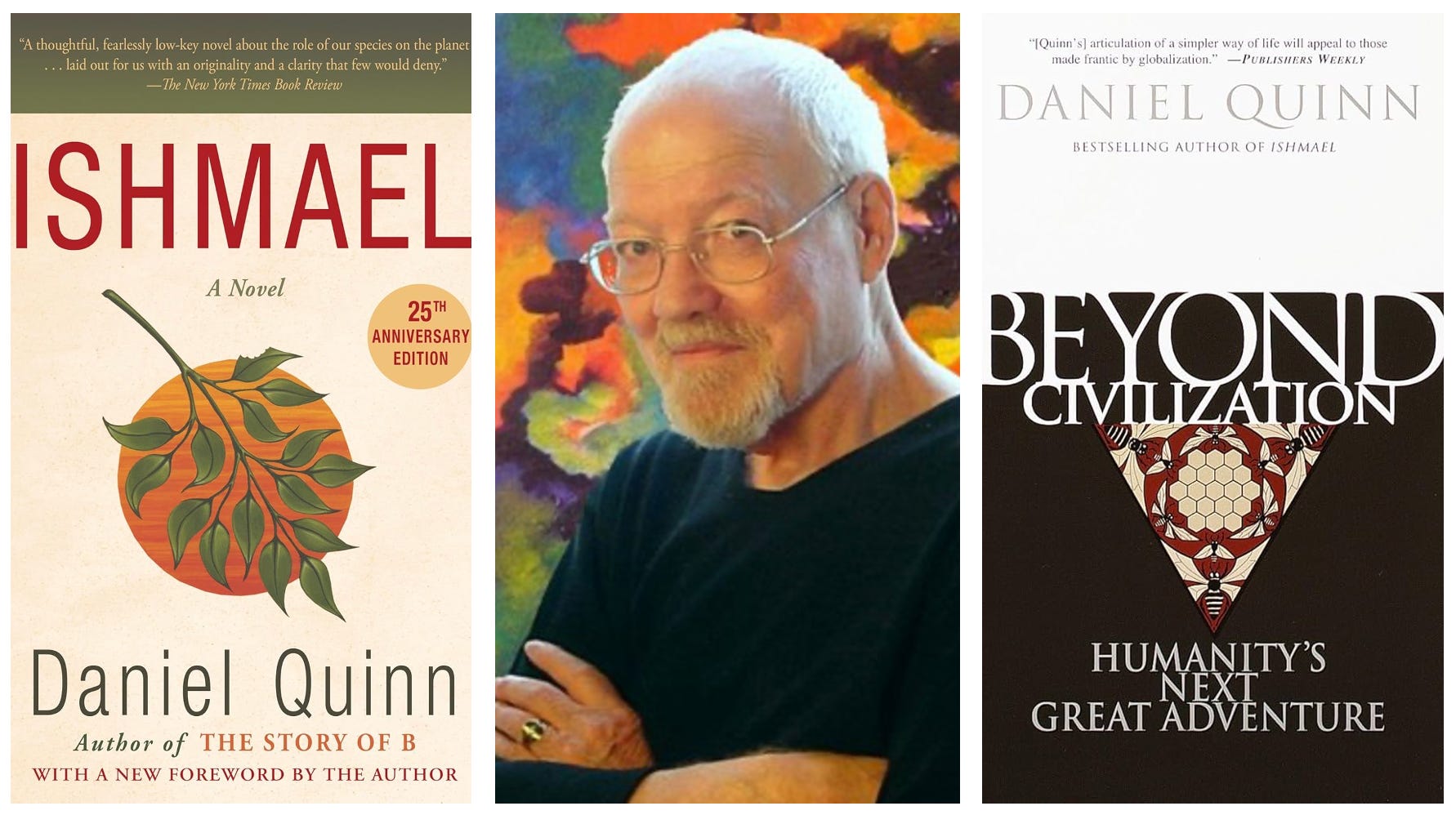
These are not civilizations that were conquered or collapsed under external pressure. Daniel Quinn, in Beyond Civilization: Humanity’s Next Great Adventure, argues something far more radical: their people grew weary of the pyramid-building logic of hierarchical civilization and walked away from it — reestablishing tribal ways of living closer to the land, closer to each other, closer to what actually worked for human beings across millions of years of evolution.
As Quinn observed, our historians find this behavior “unfathomably mysterious” — because our civilization’s deepest operating assumption, its most powerful meme, is that civilization must continue at any cost and not be abandoned under any circumstances. We will riot, revolt, burn, and overthrow — but we will not simply leave. We will replace one pyramid-builder with another, generation after generation, and call it revolution.
The Maya didn’t riot. They left.
Quinn’s formula, offered in deliberate contrast to Timothy Leary’s “tune in, turn on, drop out,” is this: Walk away. Go tribal. Think incremental.
But Quinn himself acknowledges the critical limitation of this strategy for our time: today, there are no adequate forests to walk away into. The entire planet is now inside the terminal game. Reestablishing the ethnic tribal societies of the past, planet-wide, is simply not possible.
Quinn was not alone in sensing this direction. A quiet but persistent stream of thinkers across the late 20th and early 21st centuries independently converged on the same conclusion — that humanity's path forward runs paradoxically through its tribal past. French sociologist Michel Maffesoli described it as neotribalism in The Time of the Tribes (1988), arguing that human beings have evolved for tribal rather than mass society and will inevitably reform into new tribal networks. Terence McKenna called it the Archaic Revival — a return to the shamanic, communal, and ecological wisdom of pre-civilizational life. Helena Norberg-Hodge, in Ancient Futures, documented living examples of traditional societies that had preserved what civilization had lost. Quinn called it the New Tribal Revolution — a call for diversity rather than uniformity, for new groupings of equals making a living communally, forward-thinking rather than backward-looking. Each arrived independently at the same essential insight: that the tribal form is not a primitive relic but an evolutionary wisdom that civilization suppressed but could not erase. Geotribalism is the name for what all of them were pointing toward — the conscious, developmental, post-MMO expression of the new tribalism, emerging now at the Turquoise level of the spiral, at the scale of the entire planet.
So where do we walk?
Walking Toward Each Other
This is the question that Quinn opens but does not fully answer — and it is precisely the question that the Geotribal framework was built to address.
What comes after we walk away?
We walk toward each other.
Toward the commons. Toward a world where care is currency and dignity is non-negotiable. Where value isn’t extracted — it’s created, shared, and stewarded. We walk toward Geotribalism — not a return to the past, but a leap forward into belonging at planetary scale. A one-tribe consciousness that transcends borders, markets, and the myth of separation.
Geotribalism is not nostalgia. It does not romanticize the hunter-gatherer past or suggest that the entire civilization experiment was a mistake. Where some anti-civilization activists propose going backward, and where reformists propose staying inside the terminal game while trying to improve the rules, the Geotribal vision charts a third path: calling forth the values and relational wisdom of the tribal era, but at a higher octave — integrating everything we’ve learned, built, and discovered across all eras of human development, while releasing everything that is now counter-productive to our survival.
To understand what we are walking toward — and what we must leave behind — we need to be specific about the economic DNA of civilization itself.
Beyond MMO: The Economic Inventions We Mistook for Human Nature
Here is what is so rarely named clearly: Money, Markets, and Ownership — what we might call MMO — were not features of human nature. They were inventions. Specific cultural technologies that emerged with the agricultural revolution approximately 10,000 years ago, and that hunter-gatherer tribal societies lived without for the vast majority of human existence — roughly 290,000 of our 300,000 years as a species.
Before MMO, human beings organized their economies around gift, reciprocity, and commons. Resources were shared within the tribe. Status came from generosity, not accumulation. The land, the water, the forest — these belonged to no one, and therefore to everyone. This was not primitive communism or naive idealism. It was a highly sophisticated, field-tested operating system for human survival and wellbeing, refined across hundreds of thousands of years of lived experience.
The agricultural revolution introduced surplus — and with surplus came the need to control it. Money emerged not as a neutral tool of exchange, but as a technology of control — a mechanism through which states conscripted soldiers, extracted tribute, and bound populations to hierarchies of obligation. Markets emerged as the mechanism for allocating that surplus through competition. Ownership emerged as the legal and social framework for protecting accumulated surplus from redistribution. These three inventions — MMO — are the economic foundation of what Quinn calls “civilization,” and what Schmookler identifies as the engine of the power selection trap. They are not natural laws. They are not inevitable features of human society. They are choices — choices that made sense under specific historical conditions, and that are now, under radically different conditions, threatening our survival.
To go beyond civilization, as Quinn invites us to do, means going beyond MMO — not by destroying it in a violent confrontation, but by building the post-MMO world alongside it, incrementally and intentionally, until the new system is robust enough to render the old one obsolete. The Geotribal Age is, at its economic core, the rediscovery and reinvention of the pre-MMO principles — gift, reciprocity, commons, and open access — now expressed through the full technological and consciousness toolkit of the 21st century. This is what “care is currency” actually means. This is what the open-source circle of the geotribal commons actually is. Not a return to the past, but a forward integration of humanity’s oldest and most durable economic wisdom.
The Spiral and the Higher Octave
Human cultural consciousness has evolved through eight recognizable waves, oscillating between individualistic and communal orientations — from Archaic survival through Tribal kinship, Warrior domination, Traditional order, Modern achievement, Postmodern pluralism, and Integral synthesis — each stage transcending and including what came before.
The eighth wave — Geotribal consciousness — marks the return to the communal pole at the highest level of the spiral. Like the Tribal stage (wave 2), it is communal, relational, and rooted in belonging. But unlike wave 2, it operates at a cosmocentric level of awareness — world-centric, holistic, synergistic, and open-source. It reclaims tribal wisdom without tribal limitation.
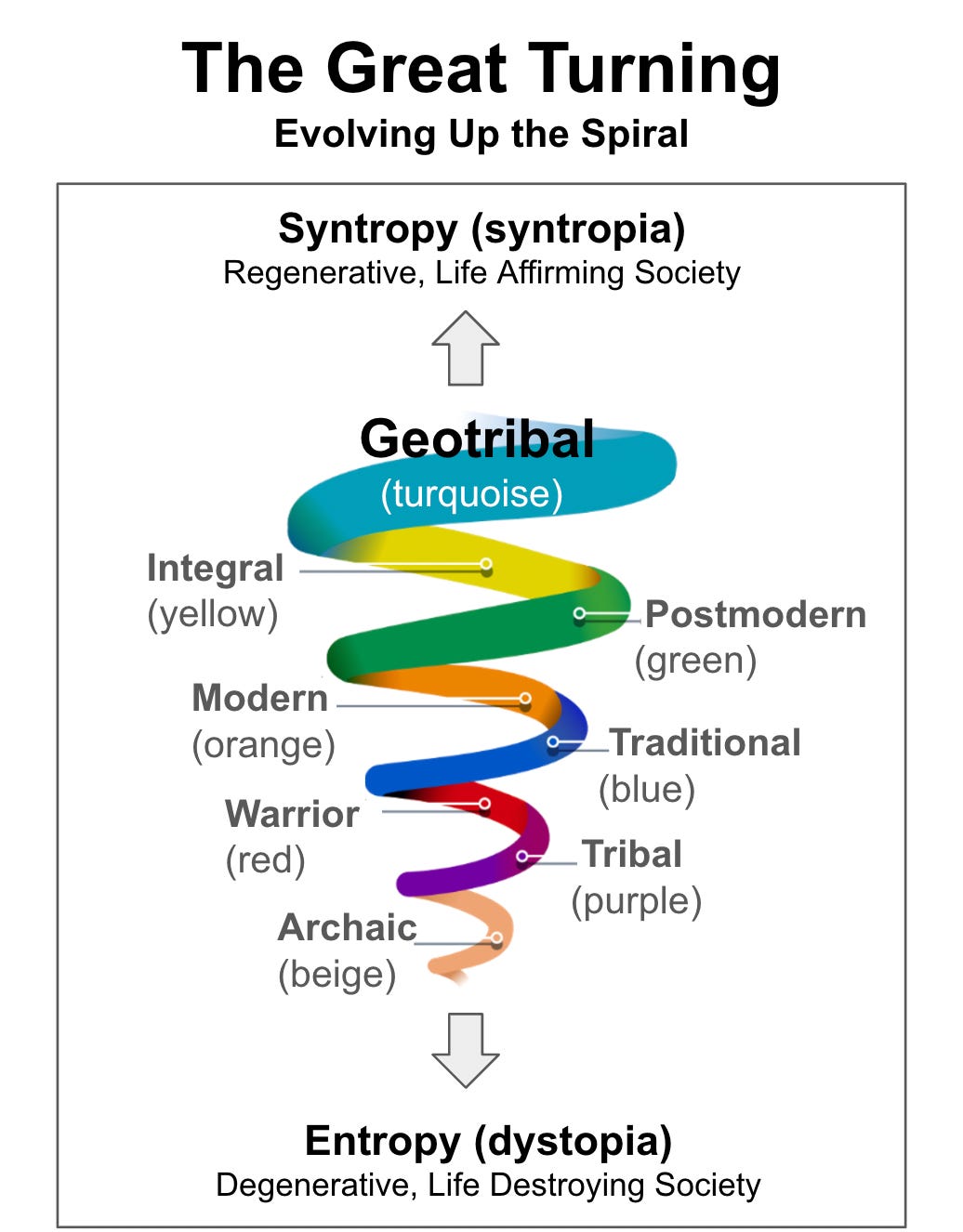
This is why the Geotribal Age is not a regression. It is a second-tier integration of what tribal humanity always knew: that human beings thrive in relationships of mutual care, face-to-face accountability, and embeddedness in living systems — not in hierarchies of extraction.
The characteristics of Geotribal consciousness include: collective individualism, holistic and intuitive thinking, global networks for local results, abundance over scarcity, open-source collaboration, unity consciousness, and a cosmocentric identity. Its intellectual companions include Ken Wilber's AQAL model — which maps all quadrants of human experience (interior and exterior, individual and collective) and provides the integrative meta-framework within which Geotribal consciousness finds its developmental home — Marshall McLuhan's global village, Rupert Sheldrake's morphic fields, James Lovelock's Gaia hypothesis, Charles Eisenstein's sacred economics, Michel Bauwens' peer-to-peer commons, and Pierre Teilhard de Chardin's noosphere.
It transcends capitalism and monetary exchange altogether — not as an ideological position, but as an evolutionary necessity.
There Is No One Right Way to Live
Quinn’s most liberating insight — drawn from the opening argument of Beyond Civilization itself — is that there is no one right way to live. He points out that we readily accept that there are countless valid ways to design a bicycle, build a shoe, or engineer an automobile. Yet somehow we remain convinced that human civilization has only one valid form — and that the one we have is it, no matter what the evidence suggests.
But Quinn’s analogy deserves a qualification that actually deepens rather than diminishes his point. While there is no single right way to build an airplane, there are natural laws of aerodynamics that all successful aircraft must honor — and no amount of democratic consensus or cultural tradition will keep a badly designed plane in the air. The same is true of human civilization. There is no one right way to live, but there are natural laws of human flourishing — ecological, social, and spiritual — that all life-affirming ways of living must honor. Ways of living that regenerate rather than deplete, that distribute rather than concentrate, that include rather than exclude, are not merely preferred — they are more aligned with the conditions that make life itself possible. The Geotribal vision is not moral relativism. It is diversity within natural law.
This is also, at its root, a question of dogma. The belief that civilization has only one valid form — that our particular arrangement of Money, Markets, and Ownership is the natural and inevitable expression of human nature — is perhaps the most pervasive and destructive dogma of our time. It is so deeply assumed that most people never recognize it as a belief at all. It presents itself not as ideology but as reality. The Geotribal vision is, among other things, a dogma killer — an invitation to examine the unexamined, to question what civilization insists cannot be questioned. And yet in doing so it does not replace one dogma with another. The antidote to the dogma of one right way is not the counter-dogma of anything goes — it is discernment grounded in natural law. Not my way or the highway, and not all roads are equal, but rather: which ways of living are most aligned with the conditions that make life flourish for the greatest number of beings across the greatest span of time? That question — asked honestly and without ideological preset — is the beginning of Geotribal wisdom.
The Geotribal vision takes Quinn’s insight and makes it generous, specific, and joyful:
We retribalize on a cosmolocal level — global and local simultaneously — but in a healthy, holistic way; not in a way that creates separation. We begin to recognize and allow for the fact that there is not “one right way to live,” and that not all people need to live as I do. We will finally realize that we are one global geotribe that allows for the beautiful diversity of many different tribes of people coexisting within the open-source circle of humanity.
People can go off and find their unique tribe — a perfect match for their heart, mind, and spirit. Geek tribes, freak tribes, burners, techies, tree huggers, scientists, new agers, atheists, religious tribes, LGBTQ tribes, artist and musician tribes, indigenous tribes, individualist libertarians, anarcho-primitivists, and traditional values tribes — all now with healthier expressions of their worldviews, because they are no longer threatened by economic survival or politically manipulated.
Just like how one flower is not better or worse than any other flower, we begin to appreciate the added beauty of each flower’s diversity as it enriches the whole garden.
And yet the garden itself operates within natural law. Every flower is unique and valid — but the garden still requires soil, water, and light. The diversity thrives because of the underlying conditions that sustain life, not in spite of them. A garden welcomes every flower; it does not welcome the invasive species that chokes all the others out. In the same way, the Geotribal commons welcomes every tribe that honors the Principle of Universal Reciprocity — but it is not a vacuum of anything goes. Some ways of living are simply more life-affirming than others, for more people, more species, and more generations yet to come. That is not judgment. That is natural law.
This is the answer to Schmookler that Quinn gestures toward but does not complete. The Parable of the Tribes trap depends on the absence of an overarching order — a meta-structure that guarantees no tribe can threaten another’s way of life. When that meta-structure exists — the open-source circle of the geotribal commons, grounded in natural law and the Principle of Universal Reciprocity — the selection pressure for domination dissolves. The terminal game ends not because someone wins, but because the rules that made it inevitable no longer apply.
The Seeds Were Already Planted: 2011
The Geotribal Age did not emerge from theory. Its seeds were planted in a remarkable convergence of movements in 2011.
Peter Joseph’s film Zeitgeist: Moving Forward, featuring Jacque Fresco’s Venus Project, introduced millions to the concept of a Resource-Based Economy — an abundant, post-monetary civilization where the Earth’s resources are the common heritage of all people. Simultaneously, the Occupy Wall Street movement erupted globally, crystallizing awareness of systemic inequality with David Graeber’s slogan: “We are the 99%.” And the integral movement, grounded in the work of Ken Wilber, Clare Graves, and others, provided the meta-framework for understanding how all of these perspectives fit together in the larger arc of human development.
These three streams mapped directly onto what Buddhist scholar Joanna Macy calls the three pillars of the Great Turning: the Zeitgeist movement embodying systems change through its post-monetary vision, Occupy Wall Street embodying holding actions through collective activism, and the integral movement embodying shifts in consciousness through its meta-framework of human development. All three pillars were present simultaneously for the first time. But they weren't yet connected or coordinated at scale.
The Geotribal rEvolution didn’t happen in 2011. Yet.
What did happen was that the genie escaped the bottle. These ideas cannot be unlearned. The awakened individuals did not disappear. And the life conditions have continued to ripen — through pandemic, polycrisis, and meaning crisis deepening the shifts in consciousness; through ecological unraveling and the rise of the Technate accelerating the need for holding actions; and through the accelerating failure of the terminal game's promises making systems change not merely desirable but existentially necessary.
The Great Unraveling and the Great Turning
We are now in what Joanna Macy calls the Great Unraveling — the convergence of interrelated crises that signals the collapse of an unsustainable way of life. The Great Simplification, as Nate Hagens describes it, is already underway: our complex industrial society, dependent on cheap energy and infinite growth, is encountering the hard limits of a finite planet.
This is not the end. It is the threshold.
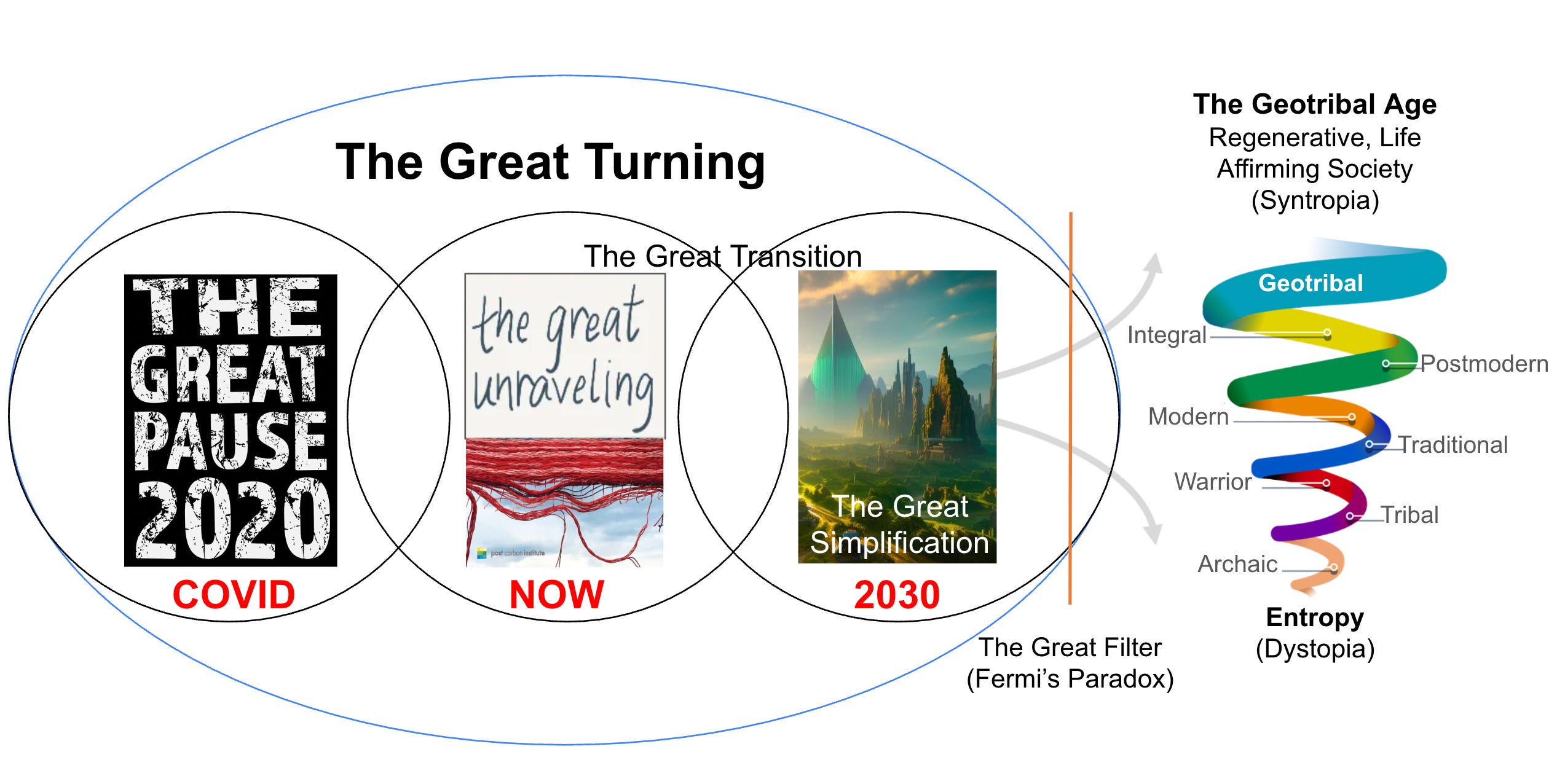
We are approaching what might be called a cultural singularity — a uniquely pivotal point that will result in one of two scenarios: breakdown toward extinction, or breakthrough to a new paradigm currently beyond our full comprehension. The trajectory of our evolutionary arrow has brought us, inevitably, to a choice point.
The three pillars of coordinated action required for the Great Turning are:
Geotribal Unity Consciousness — Embracing post-MMO possibilities as one global tribe, dissolving the meme of separation.
Coordinated Global Holding/Healing Actions — Synchronized civil disobedience, mutual aid, and regenerative care that protects what is worth protecting while the new structures emerge.
Radical Post-Scarcity Systems Change — Transforming societal structures beyond the weapons of Moloch: scarcity, competition, and incentive misalignment (SCIM).
Anything short of coordinated action in all three dimensions simultaneously leads to division, disunity, and entropy. Synergy among all three leads to what we might call syntropia — the opposite of dystopia. Not utopia (a perfect destination) but syntropia: an ongoing movement toward wholeness, beauty, truth, and goodness as the actual metrics of civilizational health.
Walkaway as Evolutionary Strategy
Here is where Quinn, Doctorow, and the Geotribal framework converge most powerfully.
Quinn demonstrates that walking away from civilizational logic is not a modern fantasy — it is a proven evolutionary strategy with historical precedent across multiple civilizations. The Maya walked away from their pyramid-building centers. The Olmec walked away. The Anasazi walked away. They didn't fight the pyramids. They stopped building them. And crucially — they survived. The Maya people did not disappear; their descendants populate Mexico and Central America to this day, their languages still spoken. The Anasazi did not vanish; they migrated and adapted, becoming the ancestors of the modern Hopi, Zuni, and Rio Grande Pueblo peoples. What collapsed was not the people but the civilizational logic — the hierarchy, the pyramid-building, the centralized extraction. The people walked away from that logic and endured. It is civilization that proved fragile, not the tribes.
Cory Doctorow’s novel Walkaway dramatizes what this looks like with 21st-century technology: people with the skills, consciousness, and community to simply leave the scarcity economy and build abundance-based alternatives alongside it — open-source, post-scarcity, communal, and radically practical.
And the Geotribal framework provides what neither Quinn nor Doctorow fully supplies: the developmental map that explains why this moment is different from every previous walkaway attempt in history. Previous walkaways moved backward — to earlier, simpler tribal arrangements. The Geotribal walkaway moves forward — to a new synthesis that integrates tribal wisdom with technological capacity and cosmocentric consciousness.
As Quinn himself asked for: walking away moving forward.
The difference is consciousness. The Maya walked away at the Tribal/Traditional level of the spiral. The Geotribal walkaway happens at level 8 — with the full inheritance of everything humanity has learned, built, and become, deliberately choosing the relational, communal, open-source, post-MMO path because we finally understand why it works.
The Scaffolding Already Exists
This is not utopia. It is not a distant dream.
All around the world, fragments of the new game already exist: mutual aid networks, cooperative farms and eco-villages, open-source technology movements, permaculture projects, post-capitalist experiments, solidarity economies, syncretic spiritual communities, and indigenous resurgences. These are not failures of the old system. They are prototypes of the new one.
They are scaffolding. Blueprint. Invitation.
New Paradigm Farms. Liminal Villages. The commons. Post-border bioregions where identity and governance flow from watersheds and living ecosystems rather than the arbitrary lines of conquest and nation-states. The cosmolocal network of geotribes already forming at the edges of the terminal game, beyond the reach of Moloch's logic — not in some distant utopian future, but right now, in ten thousand places across the planet.
You don’t have to fix the old system. You don’t even have to destroy it. You just have to walk away from its logic — and walk toward a life, and a world, worth living for.
That is rEvolution Z: the uprising without violence. The turning that dissolves power instead of fighting it. The infinite game that has already begun, waiting for the threshold moment when enough of us are playing it together.
The Geotribal Age is not coming. It is already here, in seed form — waiting, like a new story whose time has come, to be told loudly enough that everyone remembers they already knew it.
Will You Play?
Quinn gave us the diagnosis and the precedent. Schmookler gave us the theory of the trap. Doctorow gave us the near-future drama. Macy gave us the pillars of transformation. The Spiral gave us the developmental map.
The Geotribal framework gives us the destination — not as a blueprint imposed from above, but as an open invitation extended from within: one global tribe that allows for the beautiful diversity of many different tribes, coexisting within the open-source circle of humanity.
The path forward is already beneath our feet. It has always been there — in our deepest instincts for mutual care, in the memory of three million years of tribal life, in the molecular knowledge that we are not separate, that the garden needs every flower, that the river knows where it is going. It is the story being told in Parable of the Rosebush: rEvolution Z — because some truths need to be lived through fiction before they can be lived in fact.
Walk away from the terminal game.
Walk toward each other.
Evolve beyond civilization.
The infinite game has already begun.
Troy Wiley | Geotribe 2030
Key references: Andrew Bard Schmookler, The Parable of the Tribes (1984); Daniel Quinn, Beyond Civilization: Humanity's Next Great Adventure (1999); Daniel Quinn, Ishmael (1992); Cory Doctorow, Walkaway (2017); Joanna Macy, Active Hope (2012); Nate Hagens, The Great Simplification; Ken Wilber, A Theory of Everything (2000); Don Beck & Christopher Cowan, Spiral Dynamics (1996); Charles Eisenstein, Sacred Economics (2011); Michel Bauwens, P2P Foundation; Michel Maffesoli, The Time of the Tribes (1988); Helena Norberg-Hodge, Ancient Futures (1991); Terence McKenna, The Archaic Revival (1991).
Much of what you say rings true, especially about our most natural selves, what I call our DNA-dictated instincts, which have been all but completely buried under both the dominant narrative and the products of Industrial Civilization, especially during the last few decades. Now, AI may just finish the job?
There is, however, one aspect of your vision that I believe to be blurry. While you mention the finite nature of Earth's resources, you then ignore that objective truth and tell us that the evolution beyond civilization you envision will be based on a 'post-scarcity' world.
While I have a reasonable understanding of how 'contradictions' resolve themselves, I cannot see the process in this case. In fact, the quantitative changes will be decreases, not increases, so the qualitative changes will have to reflect those deprivations.
As usual, it's impossible to deliver a complete response without writing far more than you or anyone wants to read (LOL), so I'll end with: thoughts?