
Parable of the Rosebush: rEvolution Z. Chapter 6: The Liminal Season - Moloch and the Possible
Myopic "Within-the-system" Reflections From Tina Whitaker (Mother) and TINA (There is No Alternative)

<Previous Chapter | Table of Contents | Next Chapter>
Quick Recap: In Chapter 5, we followed Trim’s journey from hesitation to courage, as she left behind the familiar world and crossed the river—both literally and metaphorically. The drive, the walk, the ferry… and then the threshold. Her reunion with Zeke brought tears and grounding, and in an unexpected twist, even her mother, Tina, chose to step beyond her old patterns. Together, they crossed over—both onto new soil and into an uncertain future.
Author’s Note: The myopic “within-the-system” voices in this story aren’t just characters. They are the whispers of Moloch inside us — internal alter-egos, myths, and conditioned beliefs that shape what we think is possible. These voices — like TINA (There Is No Alternative), and others we’ve yet to meet — are mental scripts we carry without question, whispering fears, assumptions, and limits that say, ‘this is how the world works.’
Inspired by Scott Alexander’s Meditations on Moloch, they show how deeply entrenched the system is — not just in our institutions, but inside our own minds. They are Moloch’s grip on our thoughts: the internalized logic of scarcity, competition, and control that keeps us playing a self-destructive game, even when we know it’s breaking us.
Tina Whitaker
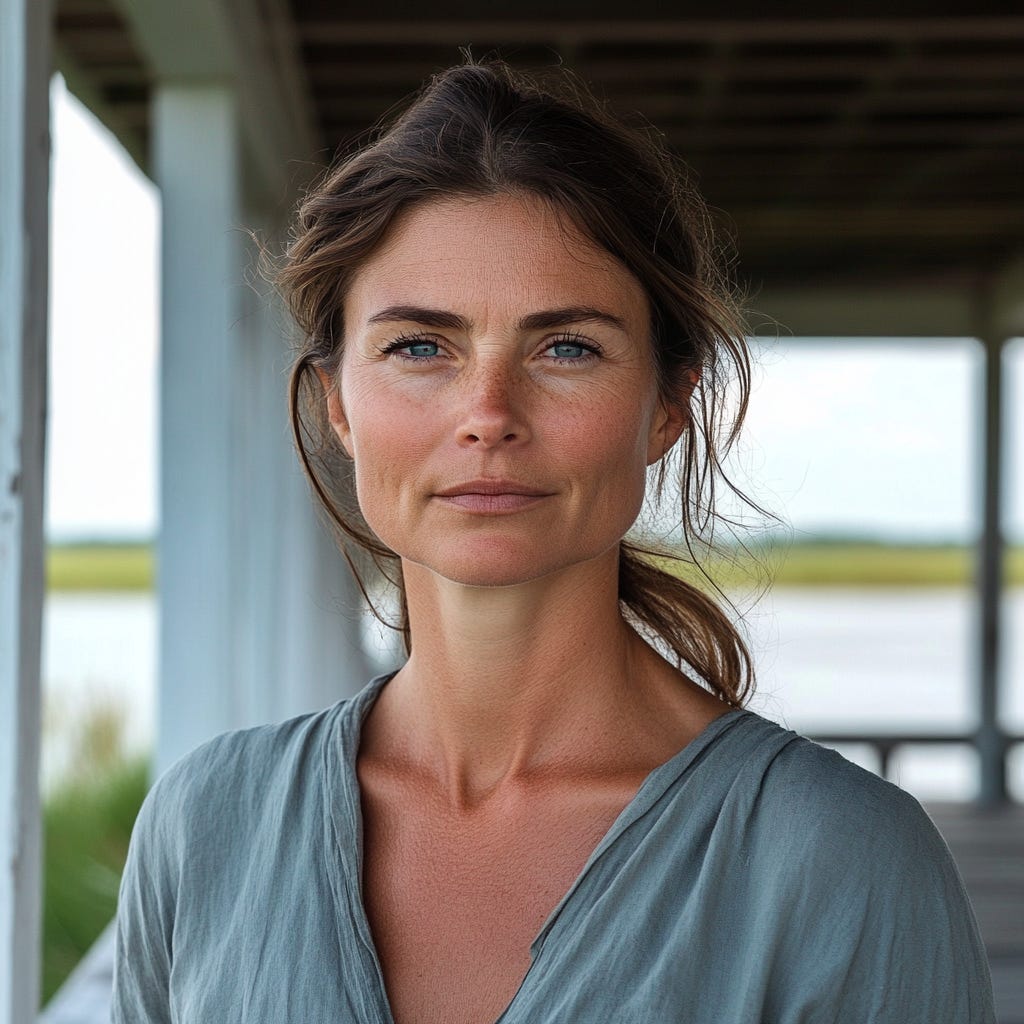
I still don’t know where I belong.
It’s October now. The leaves are turning, the air sharp with endings. I sit on the edge of the community garden at New Paradigm Farms outside of Elsah, watching Trim dig her hands into dark soil like she’s known how to do this her whole life.
She’s thriving here. I can’t deny it. She smiles more, laughs more — real laughter, the kind that comes from someplace deep and steady.
And me? I’m the one caught in between.
I spend half the week here, helping where I can. Learning things I never thought I’d need to know: how to compost, how to preserve food, how to sit still long enough to actually hear what people are saying without rushing to fix it— the way I do as a nurse, always solving, always triaging.
But every few days, I drive back to Brussels. Back to the house. Back to the bills, the grocery lists, the headlines screaming about poll numbers and economic doom. Back to my nurse’s badge on the nightstand, the hospital emails piling up, the HR forms reminding me that sabbaticals can’t last forever.
I fold laundry. I pay the utility bill online, noticing the rates went up again. I scroll through headlines: “Inflation Slows, But Pain Persists for Working Families.” “Hurricane Helene Leaves Asheville Reeling — Flooding in the Mountains Where It ‘Should Never Happen’.” “Trump Campaign Rallies Draw Record Crowds Amid Rising Divisions.”
I close the laptop with a sigh, the weight of it pressing into my chest.
The world I understand is crumbling beneath my feet — but it’s the only world I was taught to trust.
And here — at this farm — they’re building something else. My brain, trained within the system, keeps trying to make sense of it…and fails.
They talk about abundance like it’s real. They barter, they gift, they share. There are no price tags on the farm stand produce, just a sign that says: Give what you can. Take what you need.
I look at that sign, and my stomach tightens. My first instinct: How do they keep track? How does this work?
It’s not that I don’t want to believe.
It’s that I was raised to trust the system.
Work hard, earn your keep, follow the rules. That’s how you stay safe. That’s how you get ahead. That’s how you build security for your family.
But what happens when the rules stop working?
What happens when the system itself feels like quicksand?
I see it in Trim’s eyes: she’s already crossed over. She’s left the old world behind, and she’s not coming back.
And me?
I’m still standing on the threshold.
Some days, I wonder if I’ll ever step through.
TINA (There Is No Alternative)

I am TINA. There Is No Alternative.
The world makes sense when you follow the rules.
You work, you earn, you consume.
You keep your head down.
You plan for retirement, even if the numbers never quite add up.
You don’t ask why the treadmill keeps speeding up — you just run faster.
Abundance? That’s naïve.
Barter and gifting? That’s fine for idealists and hippies.
But the real world has balance sheets and bottom lines.
The real world has scarcity.
You can’t wish it away.
You want safety? Obey.
You want security? Compete.
You want meaning? Get a good job.
Dreams are nice, but reality is mortgage payments and healthcare premiums and interest rates.
It’s supply chains and quarterly earnings reports.
It’s the Dow Jones, not daisies in a field.
You’re welcome.
I’m the voice that keeps you safe.
I’m the cage you’ve mistaken for shelter.
Tina Whitaker
That night, the sky was clear and sharp with stars, the kind of night that made the air hum with something ancient. The harvest had been good. The last baskets of squash and late tomatoes sat on the long farm tables, alongside jars of pickles and honey, loaves of sourdough, and steaming bowls of soup that smelled like comfort itself.
Trim was there, barefoot, her hair wild, laughing easily with people I barely knew. They felt like family to her already. To me? They were still strangers I couldn’t quite trust.
Zeke strummed a guitar. Someone else lit the fire. Sparks drifted upward like fireflies.
I stayed back, arms folded, watching the glow dance on faces younger and older than mine, faces that didn’t seem weighed down by the same anxieties. They talked about seed libraries and rainwater capture systems, permaculture designs, and upcoming free share markets.
I caught pieces of conversation that made my stomach tighten.
“Money’s just… not necessary if we design it right.”
“Trust is the currency here.”
“We’re experimenting with post-capitalism in real time.”
I felt like I was standing on the edge of a cliff.
Trim caught my eye across the firelight. Her gaze softened. She came and sat beside me, handing me a mug of tea that smelled of mint and chamomile.
“Mom,” she said gently, “you don’t have to understand it all right now.”
I stared into the fire. “I don’t know how to live without the old rules.”
She smiled, sad and wise. “Neither do I. But we’re learning.”
And just then, the fire popped, sending up a burst of sparks.
I closed my eyes.
I wanted to believe.
But TINA’s voice whispered: Be careful. These dreams don’t pay the bills.
The fire crackled and glowed, drawing people in like moths to a flame. Laughter echoed through the night, mixed with guitar chords and soft singing.
I sat stiffly on a log at the edge of the circle, holding my mug of tea like a lifeline.
I watched as Trim joined a conversation with Zarah and one of the new volunteers. They were talking about the flooding in Asheville — how entire neighborhoods were underwater, and official help was slow or tangled in bureaucracy. But mutual aid networks were already on the ground. People showing up with shovels and pumps, helping strangers clear mud from homes, bringing food, blankets, and clean water. Zarah said that kind of spirit — people taking care of each other without waiting for permission — was exactly what they were trying to cultivate here at the farm.
I admired it. I really did. But some part of me still wondered how long that kind of goodwill could last once the crisis faded and people went back to “normal.”
But my system-trained brain screamed: What about liability? What about efficiency? What about scale?
Someone passed around a pot of soup. No one counted portions. No one asked what each person had contributed.
I felt something tighten in my chest.
If you don’t keep track, I thought, people take advantage.
But I looked around. No one seemed to be taking more than they needed. In fact, they kept offering more.
I blinked against the firelight.
What if… what if this actually worked?
And just as that thought flickered, I felt it:
TINA’s whisper, sharper this time: It works in small circles. But the real world is bigger than this fire. Don’t get swept away.
I closed my eyes. Took a breath. Held onto my cup.
I wanted to feel safe.
I just wasn’t sure where that safety lived anymore.
TINA (There Is No Alternative)
Let’s be clear. This is all very charming. The songs, the campfires, the potlucks.
But dreams don’t scale.
Barter and gifting sound beautiful until you need heart surgery. Until you need a global supply chain to deliver insulin. Until winter comes, and goodwill doesn’t heat homes.
The world runs on systems. On rules. On incentives. Without them, it all falls apart.
So go ahead. Enjoy your harvest gatherings. But when the frost sets in, they’ll come running back to the system. Because they’ll have to.
There is no alternative.
Tina Whitaker
I’ve never felt more in between.
The harvest season is nearly done here at New Paradigm Farms. The air has that bite of endings, but also beginnings. Everywhere I look, people are gathering food, canning, storing, preparing for winter. There’s a rhythm to it — ancient, steady — and yet it feels so unfamiliar to me.
Trim has found her place here. Zeke calls her “the youngest old soul he’s ever met.” I see it in her eyes. Confidence. Clarity. She belongs.
And me? I’m still straddling two worlds.
I spent half the day online reading news I wish I hadn’t. Hurricane Helene left parts of Asheville under water — Asheville, in the mountains, where flooding wasn’t supposed to happen. Is anywhere safe anymore?
Trump’s poll numbers are rising again. I can feel the tightening in my chest every time his name appears in a headline.
The genocide in Palestine continues — bodies, numbers, suffering — and the world moves on.
I feel guilty being here. Like I’ve run off to some utopian hideout while the world burns.
But here’s the strangest thing: this farm feels more real than anything I’ve known in years.
We plant, we harvest, we gather, we listen. No endless scrolling. No empty headlines. Just people showing up for each other.
Zarah told me last night that New Paradigm isn’t the only place like this. She mentioned a village in Italy — a “Liminal Village” they call it — where people come to live between worlds. Not escapism, not denial. A conscious pause. A space to question the old and experiment with the new.
A liminal village.
That’s what this place is. That’s what I’ve been standing in without even realizing it: a threshold.
And thresholds are terrifying.
Because on one side is the world I know — predictable, crumbling, but at least familiar. On the other side is the unknown.
I see Trim stepping boldly across that threshold.
And me?
I sit here, wondering if I will ever find the courage to cross with her.
I miss the certainty of rules. I miss feeling like I understood how the world worked. But I don’t miss the exhaustion. The feeling that no matter how hard I ran, the finish line kept moving.
Here, no one is running.
They’re walking. Slowly. Together.
And maybe — just maybe — that’s what safety feels like.
But I still can’t shake the fear.
What if this doesn’t scale? What if winter comes, and we’re not ready? What if… what if the old world pulls us all back in?
I don’t have answers.
All I know is this:
I’m standing on the threshold.
And the door is still open.
TINA (There Is No Alternative)
Okay, let’s be reasonable.
This is charming, sure. The community meals. The singing around the campfire. The bartering of eggs for honey and smiles.
But come on — this isn’t how the world works.
The world runs on money, contracts, supply chains, and scalability. This little micro-utopia works because it’s small.
What happens when real problems hit? When the weather patterns keep shifting and the harvest fails? When you need a specialist, a hospital, a government?
You can’t build hospitals on good vibes. You can’t scale compassion across eight billion people without structure, enforcement, and yes, hierarchy.
I know what they say: “The system is broken.” But broken compared to what? Compared to fairy tales? Compared to dreams of abundance and cooperation that sound nice but fall apart the moment someone takes more than they give?
We’ve seen it all before — communes, intentional communities, barter economies. They’re beautiful… until they collapse under the weight of human nature. Self-interest. Scarcity.
We are who we are.
And the system — flawed, brutal, exhausting — at least works well enough to keep the chaos at bay.
Doesn’t it?
What if they’re right?
But then I shake my head. No.
This is romanticism.
This is temporary.
This cannot be the answer.
Can it?
Tina Whitaker
The sun has long since set. The harvest feast is over, but the fire still crackles, sending sparks into the cool night air.
I walk back slowly from the edge of the field where I’d gone to think.
At the fire, Trim is leaning against Zeke, her face glowing in the firelight, eyes half-closed in contentment. The others are passing around a guitar, voices rising into improvised harmonies that feel ancient.
I stand just outside the circle. Watching.
They’re not performing. They’re just being.
A part of me aches to sit down, to lean in, to let myself be part of this strange, fragile magic.
But another part holds back. The part that still checks for the exits. The part that wonders what Trump said today, and whether the hospital’s HR department will approve my extended leave… my sabbatical that might become permanent.
I look around — faces lit by firelight, shadows dancing, laughter soft and real.
I think about the floods in Asheville. About the rising waters and rising tensions around the world. About the headlines I still read every morning, even when I’m here.
And then I think about the conversations around this fire:
Talk of “Liminal Villages” — places springing up like mushrooms after rain. Italy, Ecuador, New Zealand, whispers of communities that live between worlds, modeling what could be.
They call them the spaces between the old world and the new.
I wonder if this — New Paradigm Farms — is one of them.
I wonder if I could ever really belong here.
My breath catches in my throat.
I take one step toward the fire… then stop.
Not tonight.
Not yet.
I turn and walk slowly back toward the cabin.
Behind me, the fire crackles on.
Tomorrow, the garden will call again. Maybe tomorrow, I’ll answer.
TINA (There Is No Alternative)
You can’t trust this.
It’s a dream. A bubble. A momentary escape.
The real world doesn’t work like this.
You know better, Tina.
People are selfish. Resources are scarce. Systems exist because they have to.
This place — this little farm, these campfires, this talk of abundance and trust — it will crumble.
It always does.
The world is hard. The world is dangerous. You need rules. You need plans. You need control.
You’re a mother.
You don’t get to drift in dreams.
Go home. Pay the bills. Check the locks.
Remember who you are.
You are me.
There is no alternative.

Within-the-System Alter-Egos
Tina’s not the only one hearing whispers.
We all do — though most of the time, we mistake them for our own thoughts.
The system speaks from inside us, through well-worn scripts and mental reflexes.
These voices have names.
They’ve been shaping your worldview all along — you just haven’t called them out until now. Soon, you’ll meet them, but here are just some of the many voices:
CHAD – Capitalism Has All Destiny
➤ CHAD is the voice that insists capitalism isn’t just one way of organizing society — it’s the only way that can work. In CHAD’s worldview, markets are nature’s sorting mechanism: they reveal value, reward effort, and drive progress. Any attempt to replace capitalism with alternative systems is, in CHAD’s mind, naive and doomed. He believes competition is human nature, profit is proof of worth, and that without market forces, chaos and inefficiency would reign. CHAD whispers: “Why fight gravity? Capitalism is the law of nature.”
OPAL — Ownership Protects And Liberates
➤ The voice that insists private ownership is natural, necessary, and the foundation of security and freedom. OPAL believes that without property lines, patents, and personal claims, there would be chaos and exploitation — ignoring that enforced ownership often creates exclusion, inequality, and conflict. She whispers that owning more makes you safer, that boundaries protect you, and that letting go of possession invites vulnerability and disorder.
MARTY — Money’s A Reasonable Tool, Yes?
➤ The voice that insists money is just a neutral tool — not inherently good or bad — and that problems arise only from how people use it, ignoring the baked-in power asymmetries and systemic distortions it creates.
GRETA — Greed, Rivalry, Ego: That’s All
➤ The voice that insists human nature — like that of men in particular — is fundamentally selfish, aggressive, and competitive, and that any attempt to build cooperation or trust is naive idealism destined to fail.
RICK — Resources Insufficient; Control Keeps order
➤ The voice that insists scarcity is an unchangeable reality, and only rigid systems of rationing and control can keep chaos at bay — abundance is a fantasy, discipline is survival.
PENNY — Presidents, Elected iNstitutions Nurture You
➤ The voice that reassures us that elected leaders — presidents, politicians, and parliamentarians — are necessary caretakers, guiding and managing society for the greater good, because without them, disorder and confusion would take over.
CLARA — Climate Looms As Real Apocalypse
➤ The voice that fixates on climate change as the ultimate crisis, believing if we just solve carbon emissions, everything else will fall into place — unable to see that climate collapse is a symptom of deeper systemic dysfunction driven by Moloch: misaligned incentives, scarcity, and competition.
JAMES — Jobs Assign Meaning, Enslave Subtly
➤ The voice that insists having a job is not only necessary but noble — that our worth comes from laboring within someone else’s system, under someone else’s rules. JAMES1 whispers that hard work builds character, that employment is freedom, that paychecks equal purpose. But beneath that reassurance lies quiet bondage: most jobs are artificial constructs, designed not to liberate but to control. We trade our time and energy for scraps, serving systems that profit from our captivity. In truth, wage slavery is the modern extension of historical slavery — less visible, but no less real. And like the abolitionists2 who once fought to free bodies from chains, we are called now to free minds and lives from this invisible yoke. JAMES is the last great myth that must be dismantled if we are ever to truly step beyond Moloch’s grasp and reclaim our inherent worth — not as workers, but as whole, creative, sovereign beings.
RITA — rEvolution Is Terrifying, Avoid!
➤ The voice that clings to the status quo, whispering that upheaval is dangerous, chaotic, and irresponsible. RITA warns that revolutions end in blood, suffering, and loss — while quietly ignoring that staying the same guarantees slow collapse, continued harm, and deepening despair. She tells us to fear the unknown, to settle for “good enough,” and to believe that daring to transform is riskier than watching everything decay.
These internalized myths will try to hold the old world together with beliefs and assumptions.
With myths whispered through generations.
With alter-egos that sound like wisdom, but are chains in disguise.
But the cracks are widening.
The threshold has been crossed.
And beyond it…
The spiral upward begins.
But before we can rise, we must ask:
Whose voice are you still listening to?
TINA? PENNY? JAMES?
The comforting lies of the system?
Or the quiet truth stirring beneath?
In the next chapter — the final passage of Act 1 — Trim will teach us the first of five questions that have the power to dissolve those inner chains.
It begins with the simplest, and the most dangerous, question of all:
Is it true?
The spiral upward is calling.
Listen closely.
Your answers are waiting…
<Previous Chapter | Table of Contents | Next Chapter>
Author Notes:
The book James, by Percival Everett, is a powerful reimagining of The Adventures of Huckleberry Finn told from the perspective of Jim — now fully “James” — an enslaved man whose intelligence, wit, and longing for freedom are given center stage. Everett’s novel strips away the caricature and exposes the brutal reality of slavery, revealing James’ inner world, his resourcefulness, and the constant danger of a system designed to dehumanize. In the context of this chapter, James serves as a haunting reminder that systems of exploitation evolve — from chattel slavery to wage slavery — and that the myths we tell ourselves about “work” and “purpose” can bind us just as tightly as chains.
In the last chapter of my first book, The Next Copernican Revolution, I introduced the concept of The New Abolitionism — the call to liberate ourselves not just from visible chains, but from the invisible systems that enslave our minds, time, and potential. Wage slavery, institutional control, and manufactured scarcity are the modern iterations of bondage. You can read this chapter here on Substack…
