
Parable of the Rosebush: rEvolution Z. Journal Entries - November 25, December 21, 2025>>January 2, 2026. The Year We Cross Our Collective Threshold
Trim's Journal Entries: Initiation Without Elsewhere

<Previous | Table of Contents | Next>
Quick Recap: In the previous chapter, the Act II interlude stepped out of the story and into a wider, God’s-eye view. From that altitude, the converging crises of our time—climate breakdown, rising authoritarianism, accelerating technology, and social fragmentation—revealed themselves not as separate problems, but as symptoms of a deeper failure: a story that no longer coordinates reality. At the center of that story sits money—not as a neutral tool, but as a rivalrous system built on scarcity, competition, and endless growth. As exponential technologies become inexorable, these dynamics begin to self-terminate through internal contradiction rather than ideology or rebellion. Before returning to Trim’s journal, the interlude reframed Act II not as a warning about collapse, but as an exploration of conscious transition—of whether humanity can choose a different way forward.
Note to Future Me:
Remember: you didn’t come here to escape the world — you came to learn how to stay with it without becoming what broke it.
Journal Entry - November 25, 2025
By Trim Ayọ̀ Whitaker
I didn’t plan to write today. I haven’t written in a long time. Not because nothing happened. Because too much did. I feel the weight of that gap.
I’m tired in a way sleep doesn’t touch. The kind of tired that settles into your shoulders and stays there while you work, while you listen, while you pretend you’re fine because other people are clearly not.
But Thanksgiving is two days away, and everything here feels… brittle. Like if I don’t put some of this somewhere, it’s going to spill out sideways.
So I’m writing.
A year ago, I thought living in community—what people call ecovillages1 or intentional communities— meant shared meals, shared purpose, shared values. I still believe in those things. But I didn’t understand how much unhealed stuff people carry into places like this. How much pain hides behind words like regenerative and intentional.
Dad used to say that systems don’t break because people are bad — they break because people are hurting.
I’ve been carrying that sentence around like a splint. Like if I hold it just right, something inside me won’t collapse too.
I think I finally understand what he meant.
New Paradigm Farms has been both the hardest and most meaningful year of my life.
The work alone is relentless. Growing food is not poetic. It’s repetitive and physical and humbling. You plant things that don’t come up. You protect things that get eaten anyway. You watch weather forecasts like they’re omens. And even when the harvest is decent, it never feels like enough — not with food prices climbing, not with farmers everywhere barely breaking even, not with the way the system squeezes everyone until nobody can breathe.
Zarah says the problem isn’t that we don’t know how to grow food. It’s that food has been turned into a financial abstraction instead of a relationship. I don’t fully understand everything she means when she talks like that, but I can feel it in my body when we’re working the soil together.
People use the word regenerative a lot here. Regenerative agriculture. Regenerative systems. Regenerative culture.
I like the word. It sounds alive. It sounds like healing.
But sometimes it feels… small. Like we’re talking about repairing a garden while the ground underneath the garden is cracking.
We’re trying to regenerate soil, regenerate relationships, regenerate hope — while the larger systems shaping all of it stay untouched. And I can’t tell if regeneration is enough, or if it’s just the best word we have for something much bigger that we don’t know how to say yet.
Still, it’s not the work that’s breaking people.
It’s each other.
People come here wanting healing, but healing is messy. Some arrive burnt out from cities, jobs, marriages, activism. Some arrive angry. Some arrive convinced they’ve already “done the work” and everyone else just needs to catch up. Some arrive with nothing and need more than the group can give.
Money — or the lack of it — hangs over everything like humidity. Who’s contributing enough. Who’s taking too much. Who’s freeloading. Who’s quietly subsidizing the rest. No one likes talking about it, which somehow makes it worse.
There have been shouting matches in the kitchen. Passive-aggressive meeting circles that last forever and resolve nothing. People storming off, swearing they’re done with “this experiment,” only to come back a week later because there’s nowhere else to go that makes any more sense.
Mom hates this part.
She loves the land. Loves the animals. Loves the idea of people actually knowing each other again. But the group process stuff makes her crazy. She says it feels like emotional group therapy without a therapist — which might be the most accurate thing she’s said all year.
She’s threatened to leave at least four times.
And then she stays.
I think she’s as conflicted as I am. Pulled between the world she understands — schedules, money, rules — and this other way of living that feels more honest but also more exposed.
Zeke says community doesn’t create problems. It reveals them.
He said that tonight by the fire, after another governance circle that went nowhere.
Not because the questions were wrong — but because no one stayed with them long enough to hear what was underneath.
People kept interrupting. Finishing each other’s sentences. Responding before the last words had even landed.
I could feel it in my chest — the way the energy kept breaking before it could settle. Like trying to tune an instrument while everyone is still talking.
Zeke waited until the noise burned itself out. He always does.
“Listening is the hardest part of living together,” he finally said. “Because it means letting go of being right long enough to be changed.”
No one answered.
The fire cracked.
I wondered how many of our problems weren’t about food, or money, or governance at all — but about how rarely we actually let each other finish a thought.
We were all sitting there in silence afterward, staring into the flames, when Zeke dropped this.
“Everyone comes to places like this thinking they’re escaping something,” he said. “But you can’t escape yourself. You can only bring yourself somewhere new.”
Someone laughed — not kindly.
Zeke didn’t flinch. He never does.
“There’s a reason people say paradise is hard to live in,” he continued. “There’s nowhere to hide.”
That made something in me tighten.
Because Dad used to talk about A Paradise Built in Hell2 — how in disasters, when the systems collapse, people suddenly show up for each other. How money disappears and humanity surfaces. He loved that idea. Loved the proof that we’re better than the stories we tell about ourselves.
But here… sometimes it feels like the opposite.
Like hell is being built inside paradise.
Not because people are evil. Because they’re wounded. Because they’re scared. Because they’ve been shaped by a world that taught them competition before cooperation, scarcity before trust.
The ecovillage brochure is always the same.
Sunlight through palms. Open-air kitchens. Smiling people barefoot in places like Bali or Costa Rica — as if beauty itself could do the healing.
But trauma doesn’t dissolve in warm weather.
It just gets better lighting.
When people run toward paradise without tending what they carry inside, the setting turns into a mirror. And mirrors can be brutal.
And we’re trying to unlearn all of that while still living inside the same broken system.
That’s the part no one puts on the brochure.
There’s also a new guy here — Lukas. Early twenties. From Germany. Smart. Earnest. Talks fast.
He keeps saying technology can fix our coordination problems if we’re willing to “evolve our governance stack.” He wants us to use something called Holacracy, maybe DAOs (decentralized autonomous organization), maybe blockchain-based decision systems so everything’s transparent and “trustless.”
That word alone made half the room shut down.
Some people here came to get away from screens and systems and tech bros explaining the future. They want dirt under their nails and quiet evenings and fewer abstractions, not more.
The meetings have turned into this weird standoff between the technophobes and the techno-optimists. Between people who think the problem is too much technology and people who think the problem is not enough of the right kind.
Zeke just watches.
Later, when it was just the two of us hauling wood, I asked him what he thought.
He smiled that small, tired smile of his.
“Tools aren’t the issue,” he said. “The stories we build around them are.”
I don’t know what the right answer is. I just know the tension is real. And growing.
On top of everything else, one of our biggest donors pulled out last month. No warning. Just an email about “changing priorities” and “economic uncertainty.”
Zarah didn’t say much when she told us, but I saw her hands shaking.
Impermanence isn’t theoretical when you can’t pay for winter repairs. The barn door still sticks. The roof still leaks. Winter doesn’t wait for ideology.
Zarah has been quieter lately.
Not withdrawn — just careful. Like she’s measuring every word before it leaves her mouth.
I think it’s fear. Not abstract fear. Not political fear. Personal fear. The kind that listens before it speaks.
Miguel, one of the paid farmhands, didn’t show up last week. No call. No text. No explanation. He was supposed to be here at dawn, like always. He just… vanished.
Zarah tried to track him down. Friends. Family. Nobody’s heard anything. No arrest record. No notice. No trace at all.
She hasn’t said it out loud, but I can see it in her eyes. She thinks ICE took him.
And because she’s Latina too — because some of the volunteers are too — the fear doesn’t stop with him. It spreads.
People talk about it in fragments. Empty shifts at meatpacking plants. Fields left unharvested. Dairy farms selling off herds because workers are gone.
Not everyone who disappears is taken. Some are.
Others just stop showing up. They don’t come back to shifts. They stop answering phones. They decide it’s safer to disappear than to be seen — to leave town, stay with relatives, cross county lines, go into hiding, go somewhere no one asks questions.
To go God knows where.
Either way, the result feels the same.
Someone is missing.
A family is scrambling.
And the silence carries more weight than any explanation.
It’s been a year since Trump got re-elected.
That sentence still feels like it belongs in some alternate timeline I didn’t consent to. And yet here we are, living inside its gravity.
I don’t follow the news obsessively anymore. It’s too much like staring directly at the sun. But the world still leaks in — through people’s phones at breakfast, through Zarah’s voice when it drops an octave, through the way Zeke turns off the radio halfway through a sentence.
From what I can tell, the year looked something like this:
More walls. More fences. More lines drawn between “us” and “them.”
They fast-tracked new detention facilities. They don’t call them camps. They call them temporary processing centers, relocation hubs. But the photos don’t care what you name them. Rows of cots. Chain-link partitions. Fluorescent lights that never fully turn off. Kids whose eyes look older than mine.
ICE got more funding. Fewer restrictions. Expanded authority.
Those words feel abstract until they aren’t. Until someone disappears. Until a chair stays empty. Until silence becomes an answer.
Climate-wise, it felt less like an anomaly and more like a rehearsal.
The fires in Los Angeles back in January burned straight through neighborhoods that used to look like postcards — palm trees, stucco walls, infinity pools. For days the sky there turned the same color Octavia Butler described in Parable of the Sower. Ash drifting. Sunlight dulled to copper. People fleeing with whatever they could carry.
I couldn’t shake the feeling that she wasn’t writing fiction anymore.
She was doing field notes.
It’s strange — trying to grow food, trying to build community, while knowing that everything we’re standing on is unstable. That the system outside can reach in and remove someone without warning, and that the land itself — the climate, the weather, the rivers, the rhythms we depend on — can do the same.
No explanation. Just absence.
We don’t talk about it much.
But it’s there.
You can feel it in the pauses.
It’s like the outside world keeps pressing in, reminding us that this place isn’t separate. It’s embedded3. Vulnerable.
Still… there are moments.
Cooking together after a long day. Laughter that sneaks up on you. Sitting with someone while they cry and not trying to fix it. Watching Mom slowly soften around the edges, even when she’s frustrated.
I’ve grown here. I can feel it. I’m stronger. More patient. More honest with myself than I’ve ever been.
And also more aware of how fragile all of this is.
Thanksgiving is coming. We’ll gather. We’ll give thanks. We’ll probably argue. We’ll probably love each other anyway.
I don’t know what happens next.
But I keep thinking about something Dad wrote once in the margin of his notebook:
Real change doesn’t arrive gently.
It arrives when the old ways can no longer hold.
I don’t think we’re there yet.
But I can feel the strain.
Like something pulling tight beneath the surface, waiting for a release.

December 21, 2025
I didn’t want to write today either.
December does that thing where it pretends everything is winding down, when really it’s just holding its breath. The solstice always feels honest to me in a way the new year doesn’t. No fresh starts. Just darkness doing what darkness does before it turns.
The farm is quieter than it was in November. Not calmer—just quieter. The kind of quiet that settles in after too many conversations end unfinished.
The donor pulling out is starting to show now. Not dramatically. Just in the small ways that matter. Repairs postponed. A project quietly shelved. Zarah running the numbers again and again, like they might rearrange themselves if she looks long enough. No one says the word closing, but it’s there. Sitting with us.
Mom asked me last night what happens if this place fails.
Not emotionally. Practically.
Where do people go?
I didn’t have an answer.
Lukas is still here. He’s doubled down since Thanksgiving. Keeps saying crisis is exactly the moment when systems can be redesigned. He talks about resilience through decentralization. About how DAOs could keep the farm alive even if donors vanish, even if banks freeze, even if governments implode.
He means well. I believe that.
But there’s something about the way he talks—like collapse is a puzzle to be solved instead of something people are living inside—that makes my skin crawl.
At the last circle, he opened his laptop.
Diagrams.
Boxes.
Arrows.
Tokens.
Voting protocols.
Someone muttered, “I didn’t come here to live inside another app.”
Lukas looked genuinely hurt.
The conversation unraveled fast.
One side talking about trustless systems and future-proofing.
The other talking about grief, exhaustion, and wanting fewer abstractions, not more.
No one was listening again.
Zeke tried to slow it down. Asked everyone to pause. Asked Lukas what fear was underneath his urgency.
Lukas didn’t know how to answer that.
I don’t think anyone ever asked him before.
Later, by the sink, Mom whispered, “This is why people end up hating each other in communes.”
She wasn’t wrong.
And still—something about Lukas’s urgency feels real. Like he’s sensing the same fractures we are, just responding to them with the tools he trusts. Maybe all of us are doing that. Grabbing for whatever has worked before.
That’s the contradiction I keep running into here.
We’re trying to build something new while standing on a floor that’s already cracking.
And the cracks are widening.
ICE hasn’t come here. Not directly. But the fear hasn’t left. Miguel is still gone. No updates. No rumors anymore. Just absence.
Zarah keeps her phone on silent now. She says it’s for focus. I think it’s so she doesn’t flinch every time it buzzes.
A few volunteers left quietly before winter set in. No goodbyes. Just notes about “family stuff” or “needing stability.”
I don’t blame them.
Sometimes I want stability too.
But then I wonder what stability even means now. Stability inside what system? Stability for how long?
Zeke said something the other night that I can’t shake.
He said things don’t really collapse in one big moment.
They go strange first.
The story stops matching the world, and everyone keeps acting like it does.
Everything feels performative lately. The holidays. The speeches. The reassurances. Even the outrage.
Like we’re all pretending the future is still negotiable in the old ways.
He says what’s coming isn’t punishment. It’s exposure.
“Systems don’t fail,” he told me this morning while we were feeding the goats. “They reveal what they were always optimizing for.”
I asked him what ours were optimizing for.
He took a long time before answering.
“Control,” he said.
“Infinite growth.”
“Winning.”
None of those sound like survival to me.
There’s talk of new people arriving after the new year. Some because they want to help. Some because they’re running out of places to stand. And some because they’re choosing to walk away — not in protest, and not in fantasy, but in the quiet hope that stepping out might be the first step toward building something different.
Zarah mentioned someone from Colombia who may come in the new year—someone who listens differently, she said. Someone who sees patterns across land and people and history, the way elders do. The way she said it felt like a small light she didn’t want to jinx.
I didn’t ask questions.
At night, when I can’t sleep, I keep thinking about Dad’s flood stories—the ones he told long before the river took him. The way water ignores boundaries. The way it doesn’t care about ownership or intention.
Water just moves toward truth.
I don’t think what’s coming is only environmental. Or political. Or economic.
I think it’s relational.
I think we’re being tested on whether we can actually show up for each other when the rules disappear.
And I don’t know if we’re ready.
But I do know this:
Whatever the new year brings, pretending we can go back to the way things were feels impossible now.
The old story isn’t just cracking.
It’s waiting to be released.
I don’t feel hopeful exactly.
But I don’t feel numb either.
Something is gathering.
And I don’t think it will wait much longer.
January 2, 2026
The year turned the way it always does.
A small countdown. Someone popped a bottle. A few cheers. Hugs.
Yesterday felt like ritual. Today feels like reality.
And beneath it all, the quiet sense that people already knew this year would ask more of us than the last.
Just a thin layer of frost on the fields this morning—and the sense that something crossed a line while we weren’t looking.
People kept asking what I think 2026 will bring. They ask it the way people ask about weather—half-joking, half-hoping someone else has a forecast they missed.
I don’t have one.
I just have a feeling.
It’s not panic exactly. And it’s not hope in the way people usually mean it. It’s more like standing on a shoreline after the tide has pulled way, way back—when everything in your body knows the water is coming fast, but no one around you is moving yet.
I’ve been thinking a lot about escapism.
Not the obvious kind—movies, drugs, distractions. But the quieter, more respectable version. The kind that wears good intentions and linen pants and calls itself opting out.
I see it more clearly now.
So many people arrive at places like this carrying the same unspoken dream:
If I can just get far enough away from the system, I’ll be safe.
Away from politics.
Away from violence.
Away from collapse.
Away from responsibility for a world that feels too big and too broken to hold.
I don’t think that dream is wrong.
I think it’s human.
But I’m starting to see how incomplete it is.
There’s a particular kind of grief that comes with realizing there is no true elsewhere anymore.
No clean edge where the empire stops.
No untouched island where power doesn’t reach.
No rural idyll that isn’t still shaped by markets, borders, and extraction happening somewhere else.
The same forces that hollow out cities don’t politely stop at the farm gate.
They move through supply chains.
Through immigration policy.
Through debt.
Through climate.
Through the quiet disappearance of people like Miguel.
They move through us.
I think that’s what makes this moment different from the past. In other times, maybe you really could run far enough away. Disappear into a forest. Cross an ocean. Start over.
But this world is stitched too tightly now.
What happens in Washington shows up in Illinois.
What happens at a border shows up in a kitchen.
What happens in one country ripples into another before anyone can pretend it’s foreign.
Dad used to say collapse doesn’t arrive as a single event. It arrives as the realization that the exits you thought existed never really did.
I didn’t understand that when he first said it.
I think I do now.
What’s unsettling isn’t just that things feel unstable. It’s that the stories people are telling themselves feel thinner every day.
I hear it in conversations. In the way people talk about “going somewhere else” once things get bad. As if bad has a zip code. As if violence, authoritarianism, and extraction can be outrun rather than transformed.
As if the answer is elsewhere instead of otherwise.
Zeke says the urge to escape is often the first sign that people are waking up—and the last habit they have to unlearn.
“You don’t leave the burning house to build a prettier one down the road,” he said yesterday, splitting kindling with the same steady patience he brings to everything. “You figure out why houses keep catching fire.”
I keep thinking about that.
About how many people here are actually practicing for something they don’t yet have language for.
Not an escape.
A crossing.
Not a refuge from the world.
A way of being inside it without reproducing the same harm.
That’s a harder path. Less romantic. Less Instagrammable.
It asks more of us than relocating.
It asks us to heal.
To listen.
To stay when leaving would be easier.
To learn how to be with each other without the old incentives doing the work for us.
And I think that’s why this place feels so raw right now. Why it sometimes feels like hell inside paradise.
Not because it’s failing—but because it’s stripping away illusions faster than people are ready for.
I don’t think New Paradigm Farms was ever meant to be an endpoint.
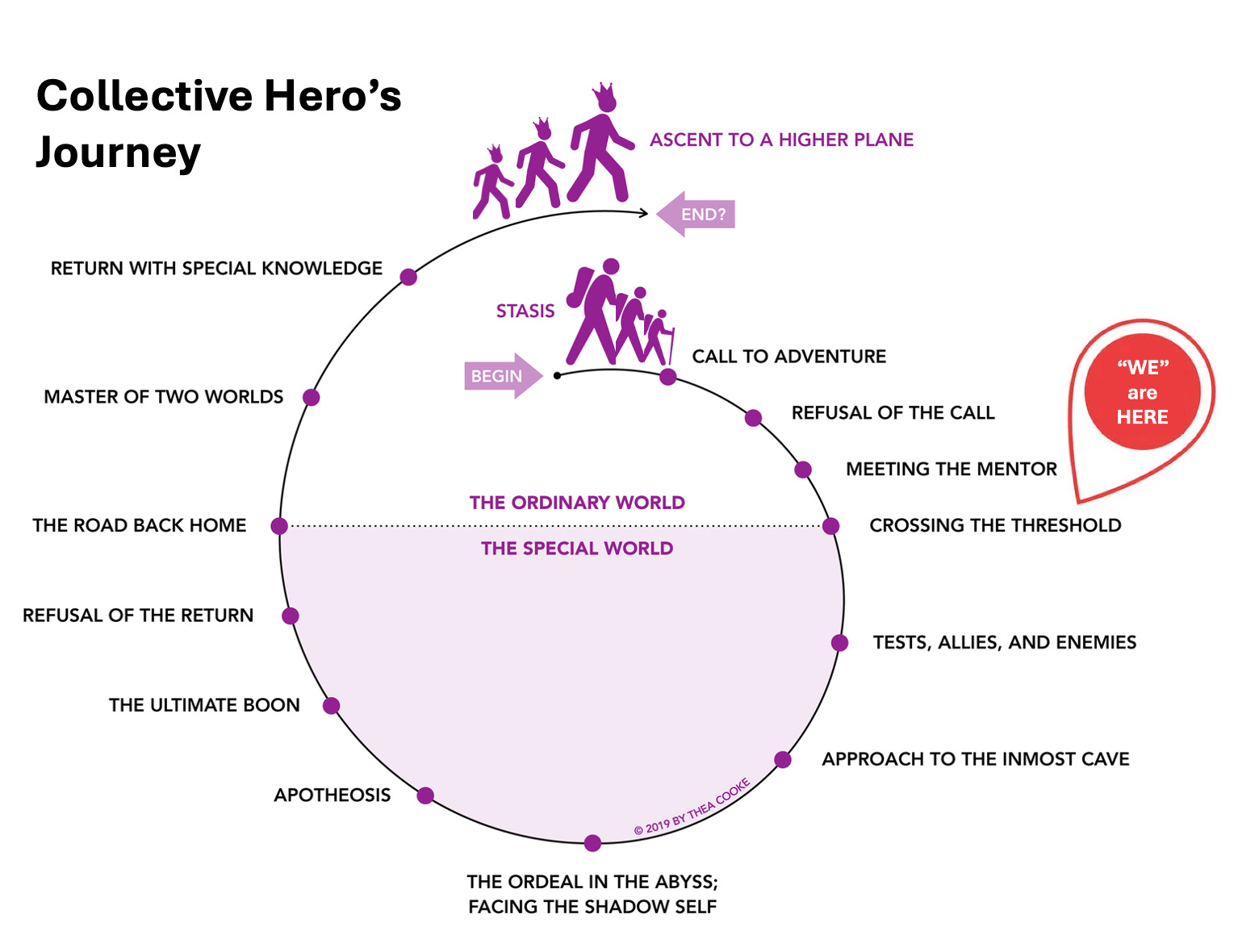
I think it’s a liminal space.4
A place between what was and what hasn’t arrived yet.
Where the old stories no longer work, but the new ones aren’t fully formed.
Where waiting feels like standing still, even though everything underneath you is moving.
I think it’s a threshold.
And thresholds are uncomfortable by definition.
You don’t get to stand in them forever.
You either step back into what you know…
or forward into something you can’t fully see yet.
The world feels like it’s holding its breath.
Not in hope.
In tension.
As if the old ways are still moving by inertia, but the deeper momentum has already shifted somewhere underneath.
I don’t know what January will bring. Or February. Or this year.
But I’m more certain than I’ve ever been of this:
There is nowhere left to run.
And strangely… that feels clarifying.
If there’s no escape, then there’s only responsibility.
Only relationship.
Only the work of becoming something different together.
I don’t know if we’re ready.
But I don’t think readiness is the point anymore.
Something is coming.
And whether we like it or not, we’re already standing in its path.
I keep thinking about the way fear makes people grab for whatever they can reach.
Branches.
Roots.
The familiar edges of the riverbank.
Dad once wrote that most suffering comes not from the current itself, but from the bruising that happens when we refuse to let go.
The water keeps moving anyway.
And the longer we cling to what’s already breaking, the more it hurts.
I don’t know where the river is carrying us. I don’t think anyone does.
But I’m starting to see that letting go isn’t giving up.
It’s choosing to stop fighting a future that has already arrived—
and learning how to move with it, into ways of living that have never existed before.
Sincerely,
<Previous | Table of Contents | Next>
Author’s Note:
In 2018, I wrote an essay titled The Next Evolution for Ecovillages: A Study of the Meaning and Relevance of Ecovillages Amid Today’s Urgency. While deeply inspired by the sincerity and regenerative promise of the ecovillage movement, I also began naming some of its recurring challenges—including forms of escapism, the emergence of “villages of privilege,” and the difficulty of building truly inclusive community while still embedded in unequal global systems. Many of the tensions explored in this chapter grow directly out of that earlier inquiry and lived experience.
A Paradise Built in Hell: The Extraordinary Communities That Arise in Disaster is a book by American writer Rebecca Solnit
Permaculture Paradigm - “Hemenway asserts that if we want to help human beings be sustainable, then that means that the larger ecosystems that we are embedded in must also be sustainable. He says we can’t have a sustainable human culture in an unsustainable ecosystem…Can we really talk “ecosystem” without talking “economy” and therefore “money”…and that means our entire global socio-economic system itself?”
Liminal Village, Italy - A place in between …
The word liminal comes from the Latin word limen, meaning threshold – any point or place of entering or beginning. A liminal space is the time between the ‘what was’ and the ‘next.’ It is a place of transition, waiting, and not knowing.
Richard Rohr describes it as:
the space where we are betwixt and between the familiar and the completely unknown. There alone is our old world left behind, while we are not yet sure of the new existence. That’s a good space where genuine newness can begin. Get there often and stay as long as you can by whatever means possible…This is the sacred space where the old world is able to fall apart, and a bigger world is revealed.
This story mirrors our current times so well. We're in that moment now where we realize there is no escape, no elsewhere. We see the failure of our systems, the corruption, the traumas, the lack of reciprocity. It's all beautifully unfolding in Parable of the Rosebush. Thank you.