
The Social Contract Is Breaking — and That’s a Good Thing
Why the Collapse of Law, Money, and Obedience Signals a Phase Change in Humanity

Editor’s Note:
This essay is not a call for chaos, nor a rejection of order. It’s an attempt to name an evolutionary transition many of us can feel but struggle to articulate. I’m not offering solutions here — only a framework for understanding why the old rules are breaking, and what that may be signaling about the phase of humanity we’re entering.
We’re told that what we’re living through is a crisis of leadership, a failure of ethics, or a breakdown of civic norms.
But what if the deeper truth is this:
The social contract didn’t fail.
It expired.
And what we’re witnessing now — the erosion of law, legitimacy, and obedience — isn’t simply collapse. It’s what happens when a system is pushed beyond the conditions it was designed to govern.
From an evolutionary perspective, this moment looks less like disorder and more like phase change.
⸻
Social Stasis and Punctuated Equilibrium
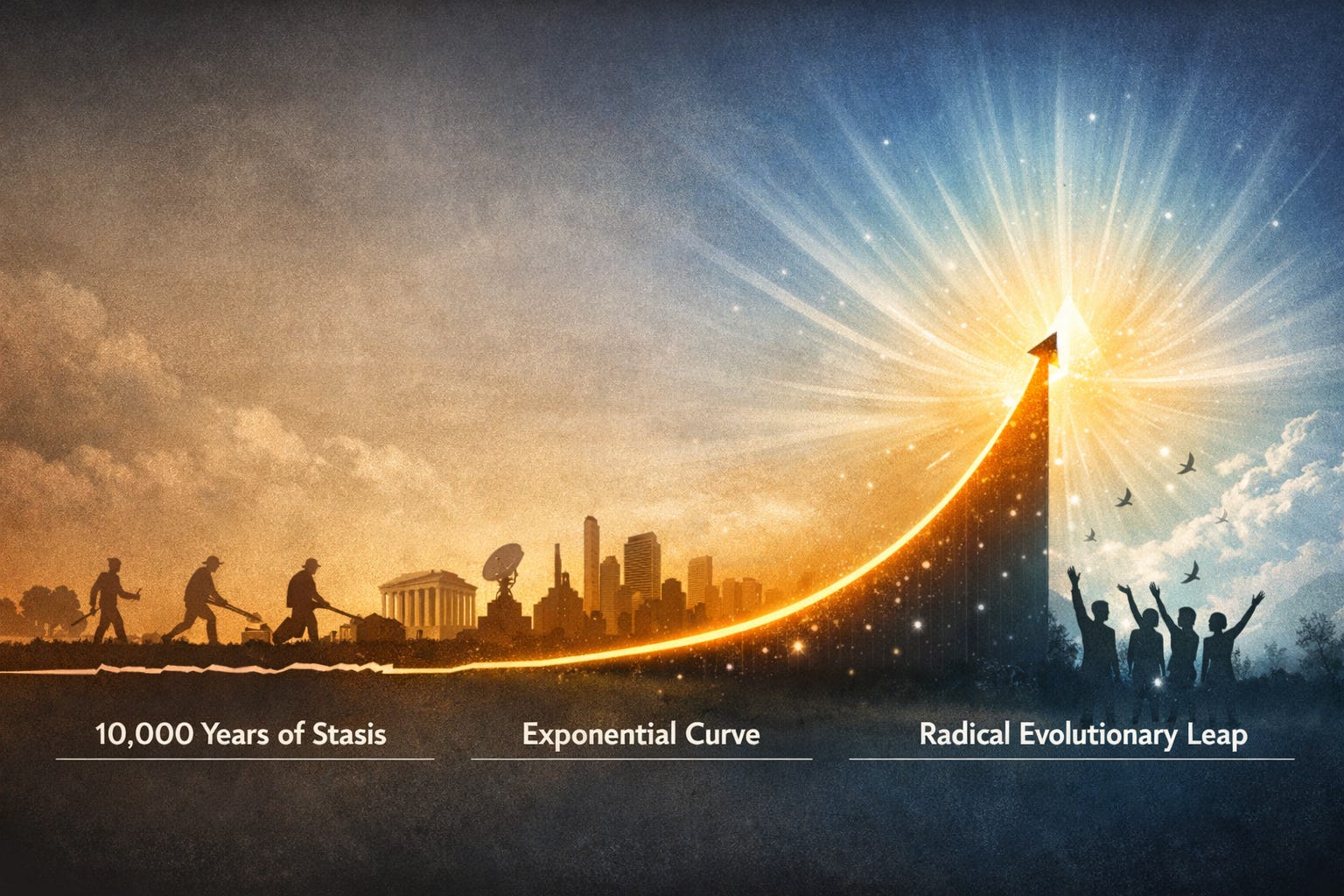
In evolutionary theory, there’s a concept called punctuated equilibrium. Species often remain in long periods of relative stability — stasis — followed by rapid bursts of transformation when conditions change.
For roughly ten thousand years, human societies have been organized around variations of the same basic structures: hierarchy, scarcity, domination, competition, property, ownership, and enforcement. Different cultures, different empires — but the same underlying operating system.
You could call this social stasis.
The rules of this system made sense within a narrow range of conditions: slow technological change, localized impact, limited coordination, and material scarcity.
But stasis never lasts forever.
When conditions change faster than systems can adapt, evolution doesn’t proceed gradually. It jumps.
And when systems resist that jump, they don’t remain stable — they produce contradictions.
⸻
Phase Change: When the Laws Stop Working — in Physics and Society
Physicists use phase change to describe transitions like ice melting into water or water turning into steam. Each phase follows different laws.
Try to apply the rules of ice to liquid water, and nothing makes sense. Push the equations of gas behavior too far, and they return absurd results — infinities, singularities, breakdowns.
That’s not because the math is wrong.
It’s because the system has changed state.
This same logic applies to social evolution.
In The Next Copernican Revolution, Book Two: Coming From the Future, I explore this idea explicitly in Chapter 6, where I describe humanity as having been locked in a long period of social stasis under dominator systems — and now crossing a threshold that makes those systems no longer viable:
“I think that humanity has been in a state of ‘social stasis’ with regards to our dominator social systems for the last 10,000 years. It’s time for another phase-change in our systems and worldviews. That’s what we’ll be exploring in this chapter—the phase-change that’s needed, the evolutionary drivers of this change, the world we can expect with the status quo, and the new world and new humanity that’s possible if we make the phase-change.”
This insight — that social systems, like physical systems, operate within limited domains of validity — has also been explored with remarkable clarity in social science fiction.
In the social sci-fi novel Voyage from Yesteryear, as analyzed in my Book Two, one character explains why Terran laws and institutions completely fail when confronted with a post-scarcity society that has already undergone such a transition:
“We’ve talked on and off about society going through phase-changes that trigger whole new epochs of social evolution…Well, that’s exactly what’s happened down there. You can’t extrapolate any of our rules into this culture. They don’t apply. They don’t work on Chiron…this whole society has gone through a phase-change of evolution. You can’t make it go backward again any more than you can turn birds back into reptiles…They haven’t gotten it into their heads yet that nothing they’ve had any experience with applies to Chiron. This is a whole new phenomenon with its own new rules.”
The key insight in both cases is the same: when existing rules begin producing contradictions, absurdities, and increasingly violent enforcement, it is not necessarily because people have failed to obey them — it is because those rules were designed for a previous phase of evolution.
This is exactly what we’re doing now.
⸻
The Rule of Law Was Built to Protect Property
The social contract we inherited wasn’t neutral.
It was constructed to protect:
• property
• ownership
• accumulation
• inheritance
• enforcement of exclusion
Law did not emerge primarily to protect life or dignity. It emerged to stabilize claims — to land, labor, resources, and surplus.
Money, markets, and ownership (MMO) are not just economic tools. They are coordination mechanisms that require law, enforcement, and obedience to function.
And for a long time, they worked well enough.
But those mechanisms assume:
• scarcity is permanent
• labor must be coerced
• resources must be priced to be allocated
• obedience is necessary for order
Those assumptions are no longer true.
And when assumptions collapse, legitimacy goes with them.
⸻
Why the Law Is Breaking Down Now
We’re watching the rule of law erode in real time:
• laws applied unevenly
• enforcement weaponized
• institutions captured
• obedience demanded without legitimacy
This isn’t accidental. It’s structural.
The law is failing because it is trying to enforce an old coordination system — MMO — under conditions it can no longer manage:
• exponential technology
• global interdependence
• ecological limits
• abundance in productive capacity
• real-time coordination
When law exists primarily to protect ownership in a world that no longer needs ownership to coordinate survival, it becomes anti-life.
And people feel that — even if they can’t articulate it.
⸻
The Breaking of the Social Contract Is a Good Thing
This is the part that’s hardest to say out loud:
The breakdown of the social contract is not a tragedy.
It’s a necessary transition.
That contract promised stability in exchange for obedience. But it no longer delivers stability — only compliance.
It protected an economic order that is:
• ecologically destructive
• psychologically corrosive
• socially fragmenting
• increasingly violent to maintain
From an evolutionary standpoint, clinging to this contract is not moral — it’s maladaptive.
Phase changes don’t ask permission.
They don’t negotiate with old laws.
They render them obsolete.
⸻
Why This Feels So Dangerous
During phase change:
• old rules lose authority
• new rules haven’t stabilized
• fear increases
• people grasp for certainty
• extremes feel seductive
This is when authoritarianism, nostalgia, and scapegoating surge. Not because people are evil — but because orientation has collapsed.
We are between operating systems.
And in that gap, everything feels unstable.
But instability doesn’t mean regression is possible.
You can’t turn steam back into ice by passing laws.
⸻
Beyond Money, Markets, and Ownership
What’s emerging isn’t just a new politics or a new economy.
It’s a new coordination logic.
Money, markets, and ownership solved coordination problems under scarcity. But they are now producing perverse outcomes under abundance and interdependence.
A post-MMO world doesn’t mean chaos. It means coordination without coercion, alignment without pricing, and stewardship instead of ownership.
We don’t fully know what that looks like yet.
The next phase doesn’t arrive as a finished map, but we can already see the limits of the old one — and glimpse what becomes possible if we evolve consciously (conscious evolution1) rather than wait for collapse to force the change.
⸻
Why This Perspective Matters Now
If you see this moment as moral failure, you’ll demand punishment.
If you see it as political dysfunction, you’ll demand reform.
If you see it as collapse, you’ll panic.
But if you see it as phase change, you’ll ask different questions:
• What assumptions no longer hold?
• Which laws are producing nonsense?
• What kinds of coordination are becoming possible now?
• How do humans think together without rivalry?
Those are the questions I’m exploring in my writing.
⸻
We Are Not Losing Order — We Are Leaving One Behind
The old social contract organized life around scarcity, obedience, and ownership.
It served a phase of human evolution.
But it is now destroying the conditions for life itself.
From an evolutionary perspective, the breaking of the social contract is not a failure of humanity.
It is humanity outgrowing its container.
⸻
Inquiry (No Debate — Just Reflection)
If you’re open to it:
• Where have you noticed laws or rules producing outcomes that no longer make sense?
• What part of the old social contract feels most obviously expired in your own life?
• What assumption about money, ownership, or obedience feels hardest to let go of?
These aren’t questions with quick answers.
They’re questions for a species in transition.
Author’s Note:
These questions aren’t meant to be answered alone. I’ve been exploring the idea of a learning commons — tentatively called the Geotribe Learning Commons — as a space for shared listening and sense-making during this transition. It’s not a program or a solution, just a container for thinking together without rushing to ideology, certainty, or false answers. I’ll share more as it takes clearer shape.
Footnotes:
Conscious Evolution - A concept from Barbara Marx Hubbard that emphasizes humanity’s ability to intentionally guide its own developmental trajectory toward higher levels of cooperation and sustainability.
It sounds like anarchism's time has come. I say that hopefully.
depending on how we define things, the mutation may not discard market, money and ownership ; only redefine them in a way that is aligned with a society caring for life to thrive in all, instead of focusing on personal or tribal / national securiy and gain ?
What would market 2.0, money 2.0 and ownership 2.0 look like, for a society in which a critical mass of its influencial members would genuinely care for all forms of living entities, seeing themselves as universal gardeners of the living miracle ?
Market 2.0 becomes a coordination system for life (re)generation, not extraction — value flows toward what makes ecosystems, bodies, souls and communities more alive, beautiful and meaningful.
Money 2.0 becomes a signal of care delivered, not power accumulated — a tracking tool for who is contributing to the flourishing of life, human and non-human alike.
Ownership 2.0 shifts from “the right to exclude and exploit” to “the dignity to steward” — you don’t own things to simply use them, you make sure that by doing so they serve at its best the web of life.
Same tools. New story. From consumers and competitors → to gardeners and guardians.