
Parable of the Rosebush: rEvolution Z. Chapter 7: The Fifth Question
Trim’s Journal Entry: When Belief Collapses, Something Greater Begins to Breathe

<Previous Chapter | Table of Contents | Next Chapter>
Quick Recap: In Chapter 6, The Liminal Season, we spent time at New Paradigm Farms as Trim settled into her new rhythm — a community between worlds. Through her reflections and her mother Tina’s “within-the-system” voice, we witnessed the tension between the old paradigm of fear, scarcity, and control, and the faint sprout of something new struggling to take root. Autumn became a mirror: a season of shedding, uncertainty, and quiet gestation. Beneath the surface, Trim was listening — to silence, to stories, to the first stirrings of a deeper shift that words could barely touch.
Journal Entry – November 6, 2024
Note to Future Me:
The moment you stop believing the old world, the new one begins to believe in you.
Morning — The Cabin
I woke to the sound of someone crying.
Not sobbing. Just a soft, stunned whimper from somewhere in the hallway of the cabin. For a moment I wasn’t sure if it was a dream. But then I heard someone else say, “It’s official.”
I sat up slowly. My breath felt heavy in my chest before I even knew why.
When I stepped into the main house, the air was thick — not with smoke or cold or anything you could name. Just… disbelief. People were gathered in twos and threes around phones and NPR on the radio, quiet, stunned, holding mugs of coffee like they needed something solid in their hands.
One of the new volunteers — Sam, I think — looked up from his screen and said, “It’s done.”
The words fell flat on the hardwood floor.
Someone whispered, “Is it true?”
Another person shook their head. “That can’t be real.”
“It is,” said Zarah quietly. “It’s real. Donald Trump won...a second time.”
It was like the whole room exhaled at once — not relief, but release. As if hope had been holding its breath, and now it had nowhere left to go.
I sat down at the end of the long dining table. A half-eaten bowl of oatmeal sat in front of someone who had wandered away. Outside, I could hear the clink of garden tools and a chicken protesting nothing in particular.
No one had to say what we were all thinking: How could this happen again?
The shock wasn’t just that he won. It was that people still didn’t believe he could.
I pulled out my journal and wrote three words:
Is it true?
Because that’s what everyone kept saying, aloud or in their eyes: This can’t be real. Not again.
And yet, it was.
And deep down, I already knew it would be.
Even though I couldn’t vote, I’d felt it for weeks. Not as a prediction. As a certainty.
Trump was going to win.
The signs were everywhere — not in the headlines, but in the spaces between them. In the mood of the country. In the tension. The hopelessness behind people’s eyes when they spoke of “change.” The way fear wrapped itself in flags and slogans.
I saw it clearly after rereading Parable of the Sower last month. Lauren Olamina’s world — which suddenly felt a lot like ours — had its own version of Trump: a man named Donner. He ran for president promising to bring back the glory and stability of a world that never truly existed. Her father planned to vote for him, even though he said politics made him sick. He called it bread and circuses: the politicians and corporations get the bread, and the people get the circuses.
Lauren said her father was the only one she knew who still believed in voting. Everyone else had already let it go — not from laziness, but from clarity. And in the end, her father didn’t vote either.
Then came the unemotional line from Lauren’s journal that stuck in my throat:
“President William Turner Smith lost yesterday’s election. Christopher Charles Morpeth Donner is our new President—President-elect.”
There was no shock, no surprise in the way Lauren wrote it.
No outrage. No protest. Just the cold, unshocked truth.
Donner had already laid out his plans to dismantle the “wasteful, pointless, unnecessary” government programs — to privatize them, to sell them off. Lauren described how he vowed to “put people back to work” by suspending so-called “overly restrictive” laws — minimum wage, environmental protections, worker safety — in a plan that read like a blueprint for modern slavery. Reading that, it didn’t feel like fiction. It felt like a warning.
And now here we were. With our own version of Donner.
And this time, no fiction to hide behind.
Midday
After breakfast, I wandered back to the cabin and opened the drawer where I kept Dad’s old journal — the one he left me, full of quotes, sketches, and entries he never shared when he was alive.
I remembered seeing something once — a note about voting and politics — but I hadn’t read it. Not then. Not when I still thought change would come in blue waves and ballots.
But today felt like the day.
I flipped through the pages until I saw it — a scribbled heading:
“The Definition of Insanity.”
I could almost hear his voice:
Einstein said it best. Doing the same thing over and over again and expecting different results. That’s what we do with voting. Every four years we show up and cast ballots as if this time it’ll matter. As if the system isn’t rigged from the foundation up. As if we haven’t been here before.
Then beneath it, a messier scrawl — angrier, faster:
Two sides of the same coin. That’s what the parties are. Coke or Pepsi. Red or blue. It’s all the same sugar water designed to keep us addicted to the illusion of choice. And we keep drinking it.
Electing singular leaders to represent millions — or billions — of people is not democracy. It’s feudalism with better branding. It’s hierarchy dressed up in ballots and suits. It’s absurd when you really think about it — we hand over our collective power to a few elites, less than 1% of humanity, and pretend that’s normal. That it’s functional. That it’s the best we can do.
He’d underlined a single phrase:
“It’s not democracy — it’s dependency.”
And the real kicker? Most of us don’t even see it. We’re born into this system and taught to believe it’s the only option. So we keep trying to fix it from within. Reform it. Vote harder. Hope the next guy’s different. But the rules of the game are set. And the game serves power. Always.
This isn’t conspiracy. This is Moloch. Competing interests, misaligned incentives, institutional inertia — the perfect storm. It doesn’t matter who wins. The system wins. Every time.
He had drawn a small diagram next to that paragraph. It was simple: a pyramid with people at the bottom, arrows pointing upward to a tiny figure at the top labeled “President.”
There are so many ways to organize human life — mutual aid, participatory councils, horizontal assemblies, direct democracy, federated networks, indigenous models, anarchist cooperatives. Real self-governance. But none of that gets airtime. None of it gets funded. None of it gets taken seriously. Because if we actually saw those options… we’d walk away from this whole charade.
We wouldn’t vote harder.
We’d stop playing the game.
I sat with that last line for a long time.
And I thought: This is what Mom…TINA (There is no alternative)…is struggling with, isn’t it?
It’s not just disbelief in an election result. It’s disbelief in a whole system she was taught to trust.
The same disbelief now cracking open in millions of people around the world.
The same disbelief I’m feeling too — not with bitterness, but with something more like awe.
How could we not have seen it sooner?
How could we not have asked,
Is it true?
That this is the only way?
That power must always rise to the top?
That governance must mean obedience?
I closed the notebook and whispered:
No. It’s not true.
I reopened the notebook.
A few pages later, I found another heading in Dad’s steadier, more thoughtful script:
“The Work — For Individuals… and for Civilizations?”
Beneath it, he’d written out a complete practice, almost like game board instructions:
Byron Katie’s “The Work”1, a powerful method of personal inquiry, cracked something open in me when I was drowning in my own thoughts, trapped in stress, blame, fear. Those four questions — they seemed so simple, almost silly at first. But they were like scalpels. They cut right to the root of suffering.
Is it true?
Can you absolutely know it’s true?
How do you react—what happens—when you believe that thought?
Who would you be without the thought?
Then came the shift:
But what if The Work, and the four questions, weren’t just for personal liberation? What if they were for collective liberation too?
What if these questions could be applied not just to trauma or relationships… but to entire systems?
To capitalism? To politics? To ownership, jobs, nations, laws?
I could almost see him pacing the room as he wrote — energized, restless, alive with the edges of something new.
Imagine applying the four questions to our biggest unquestioned assumptions:
“People won’t work unless you threaten them with poverty.”
“We need presidents and representatives to make decisions for millions.”
“Without money, everything would fall apart.”
Is it true? Can we absolutely know it’s true? How do we act when we believe it? Who might we be — as a species — without those thoughts?
He underlined that last one twice.
Then he added, almost in a whisper:
This might be the real frontier of consciousness. Not just inner work, but outer systems. A collective Work. A humanity that questions its operating assumptions, instead of dying for them.
I skimmed further down the page and saw in capital letters: The TURNAROUND. Underneath was a series of scribbled phrases, like thought experiments.
My Love…My Tina is a brilliant woman but sometimes thinks very much like a normie, like a TINA…
TINA says, like millions of people say:
➤ “There is no alternative.”
The Turnaround:
➤ “There are many alternatives.”
➤ “There is always an alternative.”
➤ “This belief is the problem — not the lack of options.”
TINA says:
➤ “People are selfish. Systems keep us safe.”
The Turnaround:
➤ “People are generous. Systems keep us stuck.”
➤ “Systems are selfish. People are safe when they trust each other.”
TINA says:
➤ “Without jobs, money, and ownership, society would collapse.”
The Turnaround:
➤ “Because of jobs, money, and ownership, society is collapsing.”
➤ “Society could thrive without jobs, money, and ownership — if we designed it differently.”
TINA says:
➤ “There is no other way.”
The Turnaround:
➤ “There are infinite ways.”
➤ “This isn’t the only way — it’s just the loudest one.”
➤ “Believing there is no other way is what’s keeping us from finding a better one.”
TINA says:
➤ “Realism means accepting the way things are.”
The Turnaround:
➤ “Realism is just someone else’s story that we’ve mistaken for truth.”
I closed the notebook slowly.
Something was shifting inside me — subtly at first, like a door creaking open somewhere deep in my chest. These phrases, these beliefs, flipped around like puzzle pieces falling into new places. Turned around.
My head was turning too.
But strangely, it didn’t feel like confusion. It felt like possibility. Like air rushing into a room that had been sealed off for too long.
Could it really be this simple?
Four questions?
They have probably only been used as self-help tools. Ways to fix yourself. Ways to stop resisting your reality.
But what if the problem wasn’t me, or you, or any of us as individuals?
What if the problem was the systems shaping that reality?
What if all these feelings of failure, shame, exhaustion — weren’t personal shortcomings, but perfectly sane responses to an insane world?
I remembered Dad quoting Krishnamurti once, his voice steady but sad:
“It is no measure of health to be well adjusted to a profoundly sick society.”
Maybe that was the real turnaround.
Not from “I am the problem” or “somebody else is the problem” — but from personal guilt to systemic clarity.
From feeling alone in the struggle to realizing it was never just you — the system itself is what’s broken, not us.
From inner blame to collective awakening.
What if it’s not that we’re broken — but that we’ve adapted, (or Mal-adapted) to a society that breaks people?
What if liberation begins when we stop internalizing the sickness of a sick society — and start questioning the stories that hold it in place?
That was the deeper shift I felt: a Turnaround of consciousness itself. A new story, struggling to be born.
My thoughts were spinning. I needed air.
I stepped outside into the crisp evening light, where the fire circle was already forming.
I didn’t go to speak.
I went to listen.
Late Afternoon — Edge of the Garden Circle
By the time the sun had dipped behind the tall oak trees, I had walked the whole loop trail twice, my boots stirring dry leaves with every step. My head was full — of questions, of turnarounds, of possibilities I didn’t yet know how to name.
So I did the only thing that made sense: I went to listen.
Back in the garden circle, people were sitting quietly, some still in disbelief. I moved slowly between small clusters — no notebook, no opinions. Just listening.
Voices murmured around the fire, scattered and low:
“…it’s not possible, not again, it can’t be…”
“…maybe we didn’t fight hard enough…”
“…how did we not see it coming?”
Everyone was spinning, trying to grasp the shape of the new reality. I don’t know what came over me. I didn’t plan to speak. Usually I only blurt things out when I hear some bullshit in class. But this wasn’t that.
This wasn’t about being clever or right.
Something in me just… welled up.
Not to offer answers.
But to ask something deeper.
So I asked a question — not to interrupt, but to open a door.
“Is it true?”
That was the first question.
Some looked at me, confused. Some blinked. One person nodded slowly. The question hung in the air.
And then came the other.
“Can you absolutely know it’s true?”
That this means it’s all over. That there’s no hope. That everything we’ve built here is now threatened.
The air felt charged. Not with answers, but with attention.
I took a breath and looked around the circle.
Then I spoke again, softly:
“How do you react — what happens — when you believe that thought?”
I said it softly, like a seed planted.
This question finally elicited voiced responses.
“I get tight,” one said. “I feel powerless.”
“I want to run,” another whispered.
I could tell more wanted to speak. I wanted to hear them all.
But instead, I listened to the next question rising in me — the one my heart wanted to ask.
“Who would you be without that thought?”
The silence stretched. A breeze moved through the drying sunflowers behind us.
“Maybe… I’d be more present,” someone said. “More grounded. Less afraid.”
I let the moment breathe. This wasn’t therapy. It wasn’t a workshop. It was a remembering — that our stories shape our reality, and we can question them.
And then, something cracked open inside me.
A phrase surfaced — one I’d heard in English class. Or maybe from Dad. Or maybe in Parable of the Sower.
Suspend disbelief.
In fiction, authors ask the reader to do that —
to suspend disbelief.
To set aside doubt. To go along with the story, even when it bends the rules of logic or physics.
But what if we’ve been doing that all along?
Suspending disbelief in our systems —
in capitalism, in presidents, in elections,
in money, in ownership, in hierarchy.
We’ve accepted them as real. Natural. Inevitable.
What if that’s the fiction?
What if the most radical act isn’t suspending disbelief in something new…
but suspending belief in the old —
and daring, finally, to suspend disbelief in what could replace it?
The Turnaround wasn’t just mental anymore.
It was mythic.
I looked around at these people — farmers, artists, dreamers, survivors — and I knew:
We’re not here to fix the system.
We’re here to unlearn it.
To listen differently.
To listen forward.
And just like that, the fifth question arrived —
not as a thought, but as words that slipped out before I could stop them.
“What if I suspend disbelief?”
The circle went quiet again. A few heads turned.
I swallowed, then laughed softly. “No — not just me.”
“What if WE suspend disbelief?”
The question hung in the air, soft but electric.
No one spoke. Only the crackle of the fire answered back.
I could feel the words circling inside me, pressing to get out.
Maybe they weren’t just mine anymore. Maybe they belonged to all of us.
I glanced around the circle — the faces, the shadows, the worry etched into everyone’s eyes.
My voice came out quiet at first.
“We’ve all been taught to believe this is the only way,” I said. “That money, power, and control are just… how the world works.”
“But what if we’ve been believing in a story that isn’t real…isn’t true?”
The fire popped. Someone shifted on the bench.
I kept going, slower now, almost to myself but still out loud.
“If we can suspend disbelief in the possibility of something new… maybe that’s where it starts."
Maybe the revolution doesn’t begin with protest signs or politics.
Maybe it begins right here — in how we think, in what we believe is possible.”
I took a breath. The words felt like they were carrying me now, not the other way around.
“Because when our minds shift, the path forward starts to show itself.”
I hesitated, then felt the current move through me again — steady, unstoppable.
“We need to stop the insanity,” I said, louder this time. “Stop believing in our fucked-up systems and start believing in an entirely new way of living as humans.”
The fire crackled. No one spoke.
But I could feel it — a collective exhale, like the whole circle had been holding its breath.
Someone nodded. Another wiped at their eyes.
Even the night seemed to pause, listening.
And in that stillness, I thought of Dad —
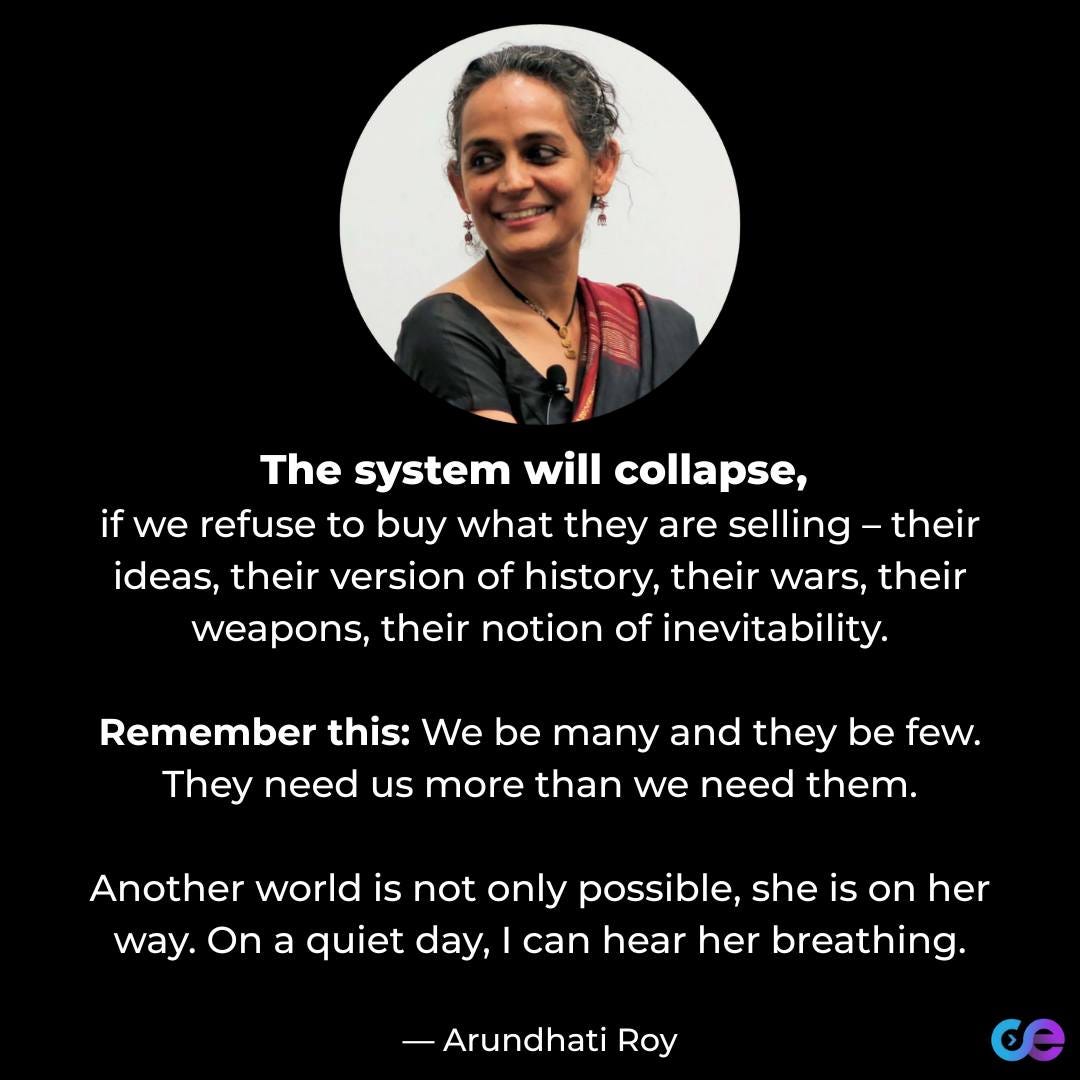
and how he used to love a quote by Arundhati Roy:
“A new world is not only possible.
She is on her way.
And on a quiet day…
I can hear her breathing.”
Maybe it begins like that —
by flooding out what we thought was true,
washing away old assumptions,
softening the hardened soil of belief.
Not with force —
but with listening.
With questions.
With presence.
Because maybe the world doesn’t change when we fight the current.
Maybe it changes when we stop gripping the riverbank —
when we stop bracing ourselves against the unknown…
and instead…let go.
That’s the secret the river taught me:
“It’s not the current that hurts you.
It’s the resistance.”
And when you release your grip —
you find you can float.
The fifth question still echoed in my chest:
What if I suspend disbelief?
That’s how all great stories begin —
not by clinging to what is,
but by opening to what might be.
And maybe this time,
we’re not just reading one.
We’re writing it.
Together.

<Previous Chapter | Table of Contents | Next Chapter>
Author’s Note:
Byron Katie’s “The Work” is a method of inquiry built on four deceptively simple questions that can dissolve stress and uncover truth. In this story, Trim begins to imagine what might happen if humanity applied those same questions — not just to personal beliefs, but to the systems that shape our lives. “The Fifth Question” is her next step — the leap from inner liberation to collective transformation.